Flagship Research Paper
A Line in the Sand
A Counter-Storytelling Account of Calvinist Dominion Theology and Its Political Machinery
By Taylor Valkyrie · 08-07-2026
A research paper tracing Calvinist doctrines of vocation, election, and worldly asceticism across four centuries to the fundamentalist homeschooling movement and eventually into the organizational infrastructure behind Project 2025. Originally an Honors Sociology capstone, expanded into the founding document of the FundieFiles archive.
This piece documents specific instances of child abuse and extremist rhetoric as part of its evidentiary record.
Jump to section ▾
- Introduction
- I. Thesis
- II. Theoretical Framework
- Max Weber and the Protestant Ethic
- Sociology of Religion and Social Movement
- Race and Individualism
- III. History and Theology
- Calvin’s Geneva and the Theology of Vocation
- American Puritanism
- Fundamentalist-Modernist Controversy (1910s-1920s)
- The 1942 Fork
- Rise of the New Christian Right
- R.J. Rushdoony - Christian Reconstructionism
- Training to Capture the Culture
- Project 2025
- IV. Organizational Case Study
- Council for National Policy
- Federal Power
- Generational Planning
- V. Policy Translation and Documented Harm
- Race: Erasure as Doctrine
- LGBTQ Rights: One Theology, Two Targets
- VI. Discussion
- Recap
- A Note on Research Method
- Elective Affinity, Outgrown
- Honest Complications: What the Fractures Reveal
- The Individualist/Colorblind Mechanism
- Purity Culture Begets Rape Culture
- Culture War
- On A Personal Note
- VII. Conclusion
- Synthesis
- On Method
- What This Argument Cannot Carry
- The Architects Are Disappearing
- To Whoever Reads This and Recognizes It
List of Figures
- Figure 1. Verses of Virtus and Poems for Patriarchs
- Figure 2. The Venture Academy DVD Training Series
- Figure 3. “We Must Rejoice in Providence if We Are to Persevere as a People”
- Figure 4. Vision Forum Ministries catalog cover art, 1998–2008
- Figure 5. The Duggars: 20 and Counting / Jubilee Award, 2009 SAICFF
- Figure 6. Witherspoon School of Law and Public Policy advertisement
- Figure 7. “One Faithful Christian Mother Can Inspire Millions”
- Figure 8. Already Gone catalog listing
- Figure 9. “A Line in the Sand” catalog cover
- Figure 10. “DW Phillips” staff biography, Kyiv Post
Introduction
I remember a pair of poetry books sitting on our coffee table when I was eight. One was titled Verses of Virtue: The Poetry and Prose of Christian Womanhood, compiled by a pastor’s wife named Beall Phillips. The other was titled, unabashedly, Poems for Patriarchs: The Verse and Prose of Christian Manhood, compiled by her husband, Douglas. That same man was also the voice behind the homeschool curriculum my family used to teach American history, with lecture titles like “Pilgrims vs. Indians: Racial Genocide or Biblical Dominion in Colonial New England?” and “Yankees vs. Rebels: Understanding the True Causes of the American Civil War.”
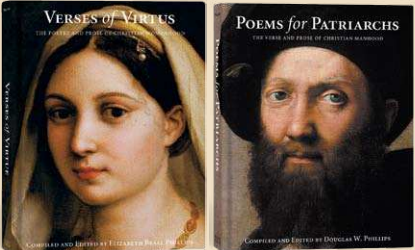
Vision Forum Ministries, the organization that published both volumes, did not present itself solely as a supplier of homeschool enrichment materials. Its own catalog copy described Poems for Patriarchs as a corrective to a nation where “the twentieth century has wreaked havoc upon manhood,” and sold its companion volume for women with the pitch that “the time has come to sing the praises of motherhood, to extol the blessings of beautiful girlhood, and to cast a renewed vision for hearth and home.” I was one of the children that vision was built for. This paper is not only about me. But it is about the machine that vision fed into, and I have spent enough of my life inside it to know exactly how deliberately it was built.
That deliberateness is this paper’s actual subject, even though it reaches far beyond one company’s catalog. American religious fundamentalism is not a static or purely theological phenomenon; it is a social movement with a traceable institutional lineage, built with the same intentionality that Vision Forum brought to a coffee-table poetry book. This paper argues that a specific theological inheritance - the Calvinist doctrines of vocation, election, and worldly asceticism that Max Weber identified as generating the “spirit of capitalism” - was carried forward, transformed, and re-politicized across four centuries into a durable organizational infrastructure. That infrastructure runs from Puritan New England, through the twentieth-century Fundamentalist-Modernist controversy, through the Christian Reconstructionist theology of R.J. Rushdoony and the homeschool-patriarchy movement that raised me, into the coordinated political apparatus of the Council for National Policy and the Heritage Foundation, and culminated in Project 2025, the 920-page transition blueprint that became, by the account of multiple contributors now serving in the current administration, the literal governing text of major federal policy in 2025-2026.
I. Thesis
To be clear, my central claim here is not that John Calvin directly caused Project 2025. It is a sociological claim about elective affinity (Weber’s term) and institutional path-dependency: a theology that locates individual worth in labor, hierarchy, and visible moral discipline produced, over time, a recognizable organizational style - tight-knit, self-replicating, media-savvy, and oriented toward capturing institutions rather than merely persuading individuals - and that style and ideology is what now backs and staffs a presidential administration. A definitional note is necessary before going further, because “fundamentalism”, “evangelicalism”, and “Christian nationalism” are routinely used interchangeably in popular writing and should not be. Following George Marsden’s work in Fundamentalism and American Culture (Second Edition, 2006), fundamentalism is best understood as “militantly anti-modernist evangelical Protestantism” - a twentieth-century reactionary movement, not simply an older, stricter form of evangelical faith. Evangelicalism is the broader tradition fundamentalism split from and periodically re-engaged with. Christian nationalism, following Andrew Whitehead and Samuel Perry, is better understood as an ethno-cultural boundary marker than as a strict measure of religiosity; it explains why this movement’s political ambitions can exceed, and sometimes diverge from, its own theological consistency. The argument that follows moves in a deliberate order, not simply a chronological one. Section 2 lays the theoretical groundwork - Weber, elective affinity, the sociological vocabulary the rest of the paper leans on. Section 3 walks the four-century line from Calvin’s Institutes to the current administration, because the theory needs to be in hand before the history reads as anything more than a list of names and dates. In Section 4, we turn from theology to organization, tracing how that inheritance became a coordinated political apparatus. Section 5 will ask what that apparatus has actually cost, and who paid that price. Section 6 steps back and asks what this case teaches, and then Section 7 ties up the threads and closes the argument.
II. Theoretical Framework
Max Weber and the Protestant Ethic
Max Weber never used the phrase “Project 2025”, because Project 2025 was a dozen decades from existing when he coined the term he actually needed. But his 1905 The Protestant Ethic and the Spirit of Capitalism supplies the single concept this paper leans on hardest: elective affinity, the idea that a theology and a social order can produce each other over time without either one causing the other outright. Weber’s own case was Calvinist predestination doctrine producing a psychological “salvation anxiety” that believers resolved through relentless, disciplined worldly labor - work not as a cause of salvation, but as a sign of it. Three of his concepts do real work here: the “calling” (Beruf), worldly asceticism, and elective affinity itself. Weber’s thesis has been challenged. R.H. Tawney and Kurt Samuelson argue he overstates causation and understates the role of pre-existing commercial capitalism - capitalism, on this view, predates Calvin. That critique does not refute the elective-affinity claim, however; it is structurally the same move made in pro-slavery theology, where a scriptural justification for an already-existing practice was supplied retroactively to sanctify what already existed. Calvinist theology did not invent capital accumulation; it simply supplied capital accumulation that was already taking place with a moral vocabulary and psychological discipline that let it scale and reproduce as a legitimate, even sanctified, way of life. “The practice predates the doctrine” is not a refutation of elective affinity - just like with Gomez Eanes de Zurara’s defense of the slave trade, the doctrine’s causal contribution is to a practice’s durability and self-justification, not to its first invention. The same logic that turned disciplined labor into evidence of grace turns up again, three centuries later, transposed onto reproduction and household government rather than economics - the same logic printed on the back cover of Poems for Patriarchs. Large families, homeschooling, debt avoidance, and “biblical patriarchy” function, in this later movement, exactly the way disciplined labor functioned for Weber’s earlier Calvinists: outward, visible proof of a household’s inward godliness. The same movement made the economic half of Weber’s argument explicit too, not just the reproductive half. Vision Forum sold a thirty-five-hour “Venture Academy” business training series pitched as replacing a “$46,000… Harvard MBA,” (VF Catalog, 2010, p. 14) alongside a “Biblical Economics” course (VF Catalog, 2011, p. 12) promising to answer “is money the root of all evil?” from Scripture, and an “Entrepreneurial Bootcamp” whose own marketing explicitly opposed itself to “the hyper-individualistic, short-sighted, postmodern vision of the fragmented family.” (VF Catalog, 2008, p. 16) When the Affordable Care Act passed, the same company ran ads calling it “Marxism” (VF Catalog, 2010, p. 43) and pointing customers toward a private health-sharing ministry instead. Weber’s Calvinist merchant, disciplined and self-denying because his salvation depended on it, has a direct twenty-first-century descendant: a homeschool father buying a DVD box set to learn accounting from a Harvard MBA, taught by men who frame the whole exercise as spiritual warfare against the state.

Sociology of Religion and Social Movement
Three further concepts recur throughout this paper. Institutional isomorphism (DiMaggio & Powell) explains why this movement’s organizations - think tanks, legal defense funds, homeschool curricula, media arms - converge on similar organizational forms across otherwise distinct theological sub-brands: Vision Forum’s catalog and the Heritage Foundation’s policy shop look nothing alike on the surface but function, underneath, almost identically. Christian nationalism as an ethno-cultural boundary marker rather than a strict measure of religiosity (Whitehead & Perry) explains why this movement’s political ambitions can exceed its own theological consistency. And patriarchy as social structure rather than mere belief - gender hierarchy functioning as the household-level unit of the same discipline/authority logic that scales up to civil governance in dominion theology - is the bridge between this paper’s household-level material and its civil-governance material two sections from now.
Race and Individualism
Michael Emerson and Christian Smith’s Divided by Faith: Evangelical Religion and the Problem of Race in America (2000) is the field-defining study here. Their core finding is that white evangelicals’ “freewill-individualist tradition” - faith as an individual, personal relationship with Christ, sin and redemption located entirely at the level of the individual soul - leads evangelicals to individualize racism, treating it as bad individual behavior fixed by individual right relationship, rather than seeing it as structural. Their own conclusion is worthy of a direct quote: American religion “can serve as a moral force in freeing people, but not in bringing them together as equals across racial lines…one embodiment of larger American contradictions.” This is a second, independent application of the same theological root Weber supplies above: an individual-accountability-before-God theology that, applied to economic behavior, produces worldly asceticism, and, applied to social structure, produces a colorblind individualism that cannot see itself as implicated in structural harm. Anthea Butler’s White Evangelical Racism (2021) explicitly makes this point its thesis: “While abortion is commonly understood as the issue that began to unite evangelicals in the 1970s, I give that dubious honor to the issue of race.” Butler’s term for the mechanism above is the “color-blind gospel”: “when some evangelicals say they don’t see color, they really mean it. They just see whiteness.” This individualism mechanism is what makes Section 5’s documented-harm material more than a list of bad outcomes. Instead, it is the theological reason a network capable of producing granular policy shows no comparable granularity about its own policy’s racially disparate outcomes. This is not a claim about Protestant or Calvinist theology as such. The Lutheran Church-Missouri Synod’s own 1996 confessional statement, Racism: A Christian Response, explicitly names racism as “idolatry,” grounds human dignity in the imago Dei (image of God), and cites three decades of synodical resolutions condemning it. This is a historically conservative, Biblically-authoritative denomination reaching a flatly different institutional conclusion from the one this paper traces as actual reality of results. The throughline runs through specific theological currents - Reconstructionist dominion theology, biblical patriarchy, the individualist-conversion emphases Emerson and Smith document - and not through broader confessional Protestant theology in general.
III. History and Theology
Calvin’s Geneva and the Theology of Vocation
Every argument in this paper eventually traces back to one Genevan reformer answering a question that has no answer: how can a person know, in this life, whether they are saved? John Calvin’s response - doctrines of predestination, the “elect,” and the calling - turned Geneva into a prototype of disciplined, church-governed civil order, and it is the root both Weber and, decades later, Rushdoony point back to directly. Calvin’s own words on calling are the direct textual seed of Weber’s Beruf concept: “The Lord enjoins every one of us, in all the actions of life, to have respect to our own calling… he has distinguished the different modes of life by the names of callings. Every man’s mode of life… is a kind of station assigned to him by the Lord… no work will be so mean and sordid as not to have a splendour and value in the eye of God” (Institutes III.10.6). Calvin’s own description of the anxiety Weber’s whole argument depends on is equally direct: “There is scarcely a mind in which the thought does not something rise, Whence your salvation but from the election of God? But what proof have you of your election? When once this thought has taken possession of any individual, it keeps him perpetually miserable, subjects him to dire torment, or throws him into a state of complete stupor” (III.24.4). This is not Weber’s theory projected backward onto Calvin. This is Calvin naming the exact psychological mechanism himself, a century and a half before anyone called it a Protestant ethic.
And on civil government - the root of both the Puritanism and Reconstructionist civil-government claims we’ll discuss later - Calvin writes: “When those who bear the office of magistrate are called gods… they are invested with divine authority, and, in fact, represent the person of God, as whose substitutes they in a manner act.” (IV.20.4, IV.20.6)
American Puritanism
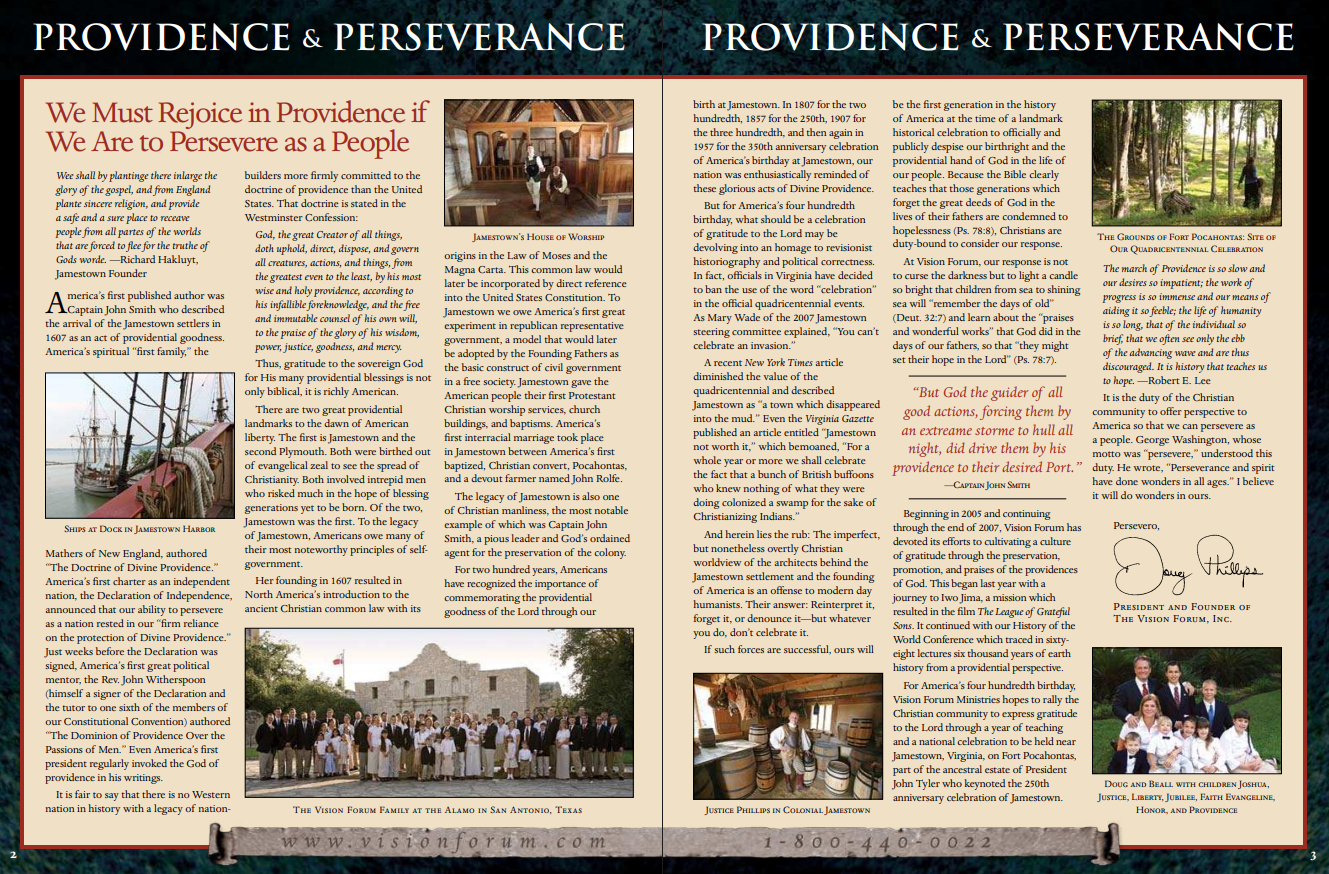
Calvin’s Geneva did not stay in Geneva. Reformed covenant theology crossed the Atlantic intact and became the self-understanding of colonial New England — a fusion of religious and civic identity that later Christian-nationalist rhetoric is still reprising four centuries on, down to Russell Vought’s description of America as “a blessing that has been God-given” that Christians are to be stewards of. The evidence here is not just mood or metaphor. The Massachusetts Body of Liberties (1641) restricted full civic “freeman” status — voting, office-eligible — to men admitted as full members of an approved Puritan congregation, and cited Ephesians 6:5 and Titus 2:9 directly to permit bondage and servitude. The 1636 capital laws went further still, listing chapter-and-verse biblical citations, mostly from Exodus and Leviticus, next to capital offenses including idolatry, witchcraft, blasphemy, and adultery — a direct civil codification of Mosaic law, 350 years before R.J. Rushdoony’s Institutes of Biblical Law made the identical move a matter of contemporary Reconstructionist doctrine. That gap is important. It is the strongest single piece of evidence in this paper that theonomy is not a twentieth-century invention grafted onto Calvinism from the outside — rather, it is a return to actual American precedent, written into law with chapter and verse back up, centuries before the theological arguments that shaped modern fundamentalism were argued. The claim that American history is itself a providential text, not merely a record of events, did not stay confined to the seventeenth century either. Vision Forum built an entire product line on it. For Jamestown’s four hundredth anniversary in 2007, when Virginia officials reportedly discouraged use of the word “celebration” for a colonial settlement and the New York Times described the anniversary as marking a “town which disappeared into the mud,” Vision Forum’s own catalog answered with a 1584 Hakluyt quote — “Wee shall by plantinge there inlarge the glory of the gospel… and provide a safe and a sure place to receave people… that are forced to flee for the truthe of Gods worde” — alongside Captain John Smith’s own account of providence steering his ship to harbor, and Robert E. Lee on “the march of Providence.” (VF Catalog, 2007, p. 2-3) The company’s response to what it called “revisionist historiography and political correctness” was not a rebuttal. It was a curriculum: A Comprehensive Defense of the Providence of God in the Founding of America, a thirty-three-disc Jamestown Quadricentennial audio collection, and an Anti-Historical Revisionism Home School Kit, sold explicitly as tools for a generation the company itself described as “the most historically illiterate American generation in history.” (VF Catalog, 2008, p. 10-11) The seventeenth century’s chapter-and-verse civil law and the twenty-first century’s DVD box set are making the same argument: that America’s history is not merely Christian in fact, but providential in structure, and that saying otherwise is itself an attack to be met and answered.
Fundamentalist-Modernist Controversy (1910s-1920s)
Fundamentalism is usually talked about as though it were simply older, stricter Christianity - a holdover that modernity eventually caught up to and mostly defeated, leaving its followers on the dying fringe. George Marsden’s framing corrects that: fundamentalism was and is “militantly anti-modernist evangelical Protestantism,” a modern reaction, not a fossil. It had something specific to react against. Walter Rauschenbusch’s Christianity and the Social Crisis (1907) argued the Kingdom of God required “social as well as individual salvation” - reframing sin as structural rather than purely personal, a Social Gospel that located moral failure in systems rather than souls. Fundamentalism organized itself as the inverse of that claim. The Fundamentals (1910-15) pamphlet series and the public humiliation of the 1925 Scopes Trial pushed the movement into a retreat of its own making - Bible colleges, separatist denominations, radio - building a parallel subculture rather than contesting the one it has lost. Its answer to Rauschenbusch was to insist that sin, poverty, and racial inequality were individual, moral failures, not structural conditions. That is the same logic the theoretical framework already named in Emerson and Smith’s account of evangelical racial individualism. The Social Gospel fight and the racial-individualism finding are, read this way, the same argument, fought a century apart.
The 1942 Fork
Most tellings of the story of Fundamentalism skip straight from Scopes in 1925 to Rushdoony in the 1960s, as though fundamentalism spent four decades simply waiting. It didn’t. It forked. In 1942, the newly founded National Association of Evangelicals explicitly rejected hardline fundamentalist Carl McIntire’s confrontational separatism in favor of cultural re-engagement. Harold Ockenga, Carl F.H. Henry, and later Billy Graham took that branch back into the mainstream, and it became postwar evangelicalism as most Americans would come to recognize it. The wing that refused to follow - distrustful of pluralism and public education, committed to building a fully parallel institutional world rather than re-entering the one it had lost - is the direct lineage that Rushdoony’s Reconstructionist theology grew out of two decades later. The claim this paper makes is not that one continuous fundamentalist movement ran unbroken from Scopes to Project 2025. It is that the movement split in 1942, and Reconstructionism - and by extension, the Patriarchy-focused homeschooling network I grew up inside - descended specifically from the branch that refused to rejoin the mainstream, while the Heritage Foundation and Focus on the Family’s founding generation trace back to the branch that did. Two grandchildren of the same fundamentalist parent, raised in different houses, meeting again half a century later at the same coalition table.
Rise of the New Christian Right
The conventional origin story, even today in the churches that are part of the Christian Right, is that the movement’s birth in the 1970s was a reaction to Roe v. Wade (1973). That story is incomplete on two ends. It starts too late, and it gets the actual trigger wrong. It starts too late because the fusion of Protestant work ethic and anti-New-Deal politics predates the 1970s by a generation. Kevin Kruse documents business-funded “Christian libertarianism” - organizations like Spiritual Mobilization, led by minister James Fifield - explicitly marrying free-market ideology to religious language as early as the 1940s and ‘50s, running in parallel with the Fundamentals-era capital funding already discussed. By the time Paul Weyrich, Edwin Feulner, and Joseph Coors founded the Heritage Foundation in 1973 as the movement’s policy-production wing, the marriage between conservative theology and conservative economics was already decades old. The conventional story gets the trigger wrong as well, or at least incomplete. What actually mobilized the movement politically has been a live historiographical argument, but that argument has moved from a historian’s interpretation to a historian’s interpretation independently and voluntarily corroborated by the founder’s own on-the-record admission. Paul Weyrich said so himself, in 1990: “What galvanized the Christian community was not abortion, school prayer, or the ERA. I am living witness to that because I was trying to get those people interested in those issues and I utterly failed. What changed their mind was Jimmy Carter’s administration’s moves against Christian schools… the attempt on the part of the IRS to rescind the tax-exempt status of Bob Jones University because of its racially discriminatory policies.” Robert P. Jones independently corroborates the broader version of this argument, documenting roughly 3,500 segregation academies serving approximately 750,000 white Southern students by the late 1970s. Race, not abortion, was the actual spark. The organizational infrastructure followed fast: the Moral Majority in 1979 (televangelist Jerry Falwell, with Weyrich as strategist), and the Council for National Policy in 1981 - founded by Tim LaHaye, the Moral Majority-aligned pastor and future co-author of the Left Behind novels; Weyrich, Phyllis Schlafly, the anti-ERA activist who led the Eagle Forum; and Richard Viguerie, the direct-mail fundraiser who helped invent modern conservative political financing - as the coordinating hub that runs, in an unbroken line, straight through to Project 2025.
R.J. Rushdoony - Christian Reconstructionism
The lineage from Rushdoony’s theology to the homeschool-patriarchy curriculum I was raised on is not an inference. It is a paper trail, and it runs through one family for three generations, back to Calvin himself. R.J. Rushdoony founded the Chalcedon Foundation in 1965 and, with it, the doctrine of theonomy — the claim that Old Testament civil law is binding on civil society. Per Michael McVicar’s biography, Rushdoony believed education, not electoral politics, was the movement’s real battlefield: only “a rigorously developed educational agenda rooted in a Calvinist criticism of modernity” would free Christians from modern statism. Howard Phillips — a longtime conservative political operative and three-time presidential candidate (1992, 1996, 2000) — heard that argument directly and raised his son Doug on Rushdoony’s own audiobooks. Doug Phillips later wrote the marketing copy for his own company’s edition of one of them: “As a boy traveling with my father, many happy hours were spent discussing the lessons we were learning from the wonderful books on tape my father provided for our family. One of the most influential I listened to was Dr. R.J. Rushdoony’s A Christian Survey of World History” (VF Catalog, 2003, p. 33). Vision Forum sold that book, and several others by Rushdoony, continuously for over a decade. This is the same formation model this paper’s own introduction describes — a childhood shaped by audio recordings and assigned reading, chosen by a father, meant to produce a specific kind of adult — one generation removed, and in Doug Phillips’s own words rather than mine. The company said the quiet part out loud in a 2010 newsletter, under the heading “Building the Dedicated Minority through ‘Conspiracies of Friendship’”: “We are reminded of R.J. Rushdoony’s observation that history is not made through majorities, but through dedicated minorities… ‘conspiracies of friendship’ — handfuls of men and women… like the Reformers of the 16th century, who God raised up to influence and change the culture of their day” (“Vision for 2011” Newsletter, 2010, p. 11). This is not a household privately absorbing Reconstructionist theology as background influence. It is an organization naming Rushdoony, and Calvin’s own era by direct comparison, as its explicit strategic doctrine — the theory of change behind every conference, every catalog, every curriculum sale. That comparison was not incidental. Vision Forum returned to Calvin constantly — his own branded Bible edition, his own biography, a DVD reenactment of him debating Charles Darwin, conference lectures on “the Global Influence of John Calvin.” The clearest statement of what all of it amounted to came in 2013, the same year Howard Phillips died. Doug Phillips’s tribute to his father, published that May, was titled “The ‘Miracle’ of Dad’s Ten Thousand Grandchildren” — a homeschool movement’s demographic reproduction measured as its own theological legacy, the same worldly-asceticism-as-evidence-of-election logic this paper traces back to Weber, now counted in spiritual grandchildren instead of grace. Months later, at that same year’s “History of America Mega Conference,” senior associate Geoffrey Botkin quoted Rushdoony directly — “education is inescapably a religious discipline… whoever controls the education of a people directs their faith and their religious worldview” — while, on the same stage, Pastor Joseph Morecraft told the audience: “Arguably the most important Founding Father for America was not George Washington, but John Calvin.” Calvin, Rushdoony, and Phillips are not a throughline this paper is constructing. Within Vision Forum’s own materials, in the same year, at the same conference, they are one line — spoken by the movement about itself, requiring no academic mediation to draw the connection. One more pattern deserves to be named plainly here. Across the eleven years this section draws from, Vision Forum organized its own yearly self-presentation around war. The catalog themes ran, year after year: Discipleship and Dominion (2003), A Line in the Sand (2005), Faith of Our Fathers (2006), Providence and Perseverance (2007), A Vision of Victory (2008), Provision and Protection 2010), Fight Hard and Hold Fast (2011). That is not incidental branding, repeated by coincidence. It is a decade of a company telling its own customers, every single year, that they were at war — a vocabulary of siege this paper returns to in its discussion of what the movement’s institutional strategy actually required of the people living inside it.

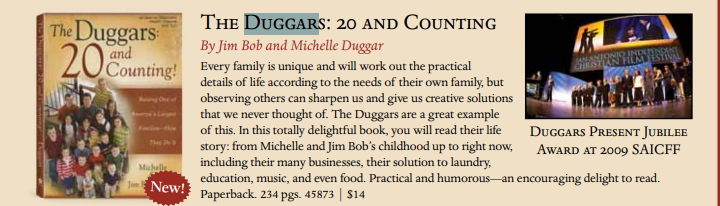
Vision Forum was not the only institution shaping this world, and naming its closest neighbor matters here. The Institute in Basic Life Principles (IBLP), founded by Bill Gothard in 1961, built a parallel homeschool curriculum — the Advanced Training Institute (ATI) — organized around Gothard’s own doctrine of household hierarchy, most durably summarized in his “umbrella of authority” teaching: a wife and children stood protected only so long as they remained under a husband’s or father’s covering, and stepping outside it, in any sense, meant stepping outside the protection as well. IBLP reached a far larger public audience than Vision Forum ever did, largely through the Duggar family, whose television presence on 19 Kids and Counting (2008–2015) made ATI’s curriculum and Gothard’s household teachings visible to millions of viewers who had never heard of Vision Forum at all. The connection between the two organizations was not commercial. Vision Forum did not sell Gothard’s materials or list IBLP in its catalogs the way it marketed Rushdoony’s audiobooks. The tie was social, and the record of it is public: the Duggars, IBLP’s flagship and most public-facing family, regularly attended Vision Forum’s own conferences, appeared as award presenters at the 2009 San Antonio Independent Christian Film Festival, and were featured repeatedly in Vision Forum’s own publications — a relationship documented in the 2023 docuseries Shiny Happy People. Doug Phillips and Bill Gothard moved in the same homeschool-patriarchy circuit, shared the same conference stages and the same extended network of families, and treated each other’s institutions as allied rather than competing versions of the same project. Two organizations, two curricula, one theology of hierarchy, running side by side through the same households for a generation.
Training to Capture the Culture
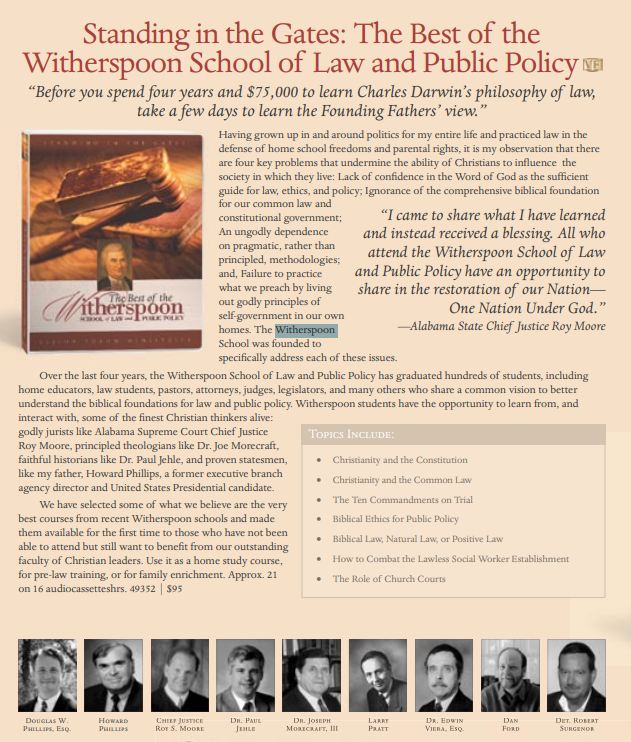
The New Apostolic Reformation is a loosely networked, non-denominational charismatic movement, organized less around church membership than around self-identified modern-day apostles and prophets who claim direct governing authority over both the church and the wider culture. By the time it gave a name to the strategy of capturing the culture sphere by sphere - the “Seven Mountain Mandate” discussed below - the Reformed side of this paper’s throughline had already been running the training programs for more than a decade. Vision Forum’s own materials show a movement building infrastructure across nearly every sphere the “Seven Mountain Mandate” would later name. In media, through the San Antonio Independent Christian Film Festival and a book titled Outside Hollywood: The Young Christian’s Guide to Vocational Filmmaking, whose marketing predicted that “like the Berlin Wall, the seemingly impenetrable colossus of Hollywood… will someday come crashing down” (VF Catalog, 2006, p. 47); the same year’s catalog described the goal of its film curriculum as changing “the terms of debate for this crucial medium of cultural influence by challenging the Hollywood giant” (2006, p. 44), and accused the entertainment industry of a deliberate campaign, beginning in 1923, to seize what it called “cultural hegemony” (2006, p. 6) — a term borrowed, unacknowledged, from the Marxist theorist Antonio Gramsci to describe exactly the strategy Vision Forum was now openly building a Christian counter-version of. In law and government, through the Witherspoon School of Law and Public Policy, whose faculty included Alabama Chief Justice Roy Moore and Howard Phillips himself (2003, p. 32). In business, through the Venture Academy and Entrepreneurial Bootcamp already discussed. In education, through the entire homeschool curriculum apparatus this paper has already traced. This was not incidental overlap between two movements. It was the same sphere-by-sphere ambition the charismatic movement would soon formalize with a name, already being built in practice, years earlier, by a Reformed organization that had no reason to call it anything but obedience. Genesis 1:28 says almost nothing on its own — “have dominion… over every living thing” is eight words of Hebrew scripture that most Christian traditions read as a general statement about stewardship. Two very different American religious movements read it as an operating manual, and by the time their two roads converged, they had arrived at functionally the same infrastructure. Rushdoony’s road ran through Reformed theology: “Dominion is God’s principle for man over nature (Gen. 1:28), and for the male in the person of the husband and father in the family” — a household-level, patriarchal reading, developed inside Presbyterian confessional tradition, that this paper has already traced from Calvin’s Geneva through Vision Forum’s own catalog. The other road belongs to a movement with no Reformed lineage at all: the New Apostolic Reformation, a charismatic, Pentecostal-adjacent network organized around the “Seven Mountain Mandate” — the explicit claim that Christians are called to seize dominion over seven specific spheres of culture: religion, family, education, government, media, arts and entertainment, and business. NAR figure Dutch Sheets calls this project “ekklesia theology”: the church understood not as a congregation but as “a governing body,” tasked to move from “a congregational mindset to a congressional mindset” and to “legislate in the spirit, [then] implement in the natural” — language he ties explicitly to “the restoration of the dominion mandate of Genesis 1.” Matthew D. Taylor, a religion scholar who has studied the movement closely, notes he has “searched in vain for any respected biblical scholarship” supporting Sheets’s reading, calling it “charismatic dominion theology 2.0.”
Two traditions arriving at the identical verse, the identical claim, and — as the record now shows — nearly the identical institutional strategy, is exactly the kind of convergence this paper’s theoretical framework predicts. It would be strong evidence for elective affinity even if the two traditions were genuinely independent. They are not quite. Taylor traces the Seven Mountains concept’s actual genealogy directly through Reformed sources: “the idea of dividing society up into different spheres of authority and imagining Christian influence in each goes back a long way in Protestant theology, at least to the thought of Abraham Kuyper,” the early-twentieth-century Dutch Calvinist theologian and prime minister — “you could trace some elements of this idea back to John Calvin himself.” By the 1970s, Taylor writes, those ideas were “enjoying a resurgence through the spread of Christian Reconstructionism,” and what emerged from the encounter was “Kingdom Now theology” — a 1980s fusion in which “the Reformed Reconstructionists’ extreme ideas about dominion theology were cross-pollinating with Independent Charismatic networks’ Latter Rain revivalism.” The convergence is not two strangers independently discovering the same idea. It is a documented historical merger, one this paper’s own throughline runs directly through — and Vision Forum’s own decade of catalogs is the material record of what the Reformed half of that merger was doing while the charismatic half was still finding its name for it. What survived the merger, on both sides, is a shared operating strategy more than a shared theology. Hanne Amanda Trangerud’s 2025 peer-reviewed study identifies three mechanisms both wings share regardless of their theological daylight: replacing existing elites with “their own people”; operating through loosely linked, formally independent, functionally interdependent networks rather than top-down hierarchies — the same institutional isomorphism this paper’s theoretical framework already named; and a shared ideology both call “conservative Christian nationalism,” defined against a common enemy, “cultural Marxism.” Two theological pathways, one fork older than the other, converging on the same seven-spheres strategy — and about to converge on the same administration.
Project 2025
Everything I’ve traced in this tour of theological history - Calvin’s Calling, Rushdoony’s theonomy, Vision Forum’s decade of dominion curricula, the Reformed and charismatic convergence on seven-sphere capture - has a governing document now. It is nine hundred and twenty pages long, and it has a name you’ve heard: Project 2025. Heritage Foundation’s “Mandate for Leadership” series, a tradition running back to 1981, was formalized into the 2025 Presidential Transition Project - a coalition effort, led by Heritage, that produced a detailed policy blueprint for a second Trump administration before that administration existed. The personnel pipeline from the document’s own authorship into the current government is documented, not inferred: contributors and endorsers moved directly into the Office of Management and Budget, the Department of Justice’s Office of Legal Counsel, the Department of Health and Human Services, and the Federal Communications Commission. Russell Vought, Project 2025’s chief architect for the executive-branch chapter and now OMB Director, supplies the clearest evidence that this paper’s theology cashes out in a specific, named theory of executive power, not just a general political disposition. In his own words: “The Right needs to throw off the precedents and legal paradigms that have wrongly developed over the last 200 years.” On independent agencies: “The whole notion of an independent agency should be thrown out.” On the civil service, tied directly to Schedule F and the 2025 mass reductions-in-force: “We want the bureaucrats to be traumatically affected… we want their funding to be shut down.” Finally, on withholding congressionally appropriated funds, directed executed in 2025 OMB funding freezes: “I don’t believe it’s constitutional, the President ran on that view, that’s his view and I agree with that.” Kevin Roberts, current president of the Heritage Foundation, closes the theoretical loop this paper opened with Calvin and Weber. In July 2024 he said: “We are in the process of the second American Revolution, which will remain bloodless if the left allows it to be,” and, in the same broadcast, “God’s law can, in fact, be a huge influence on the civil laws…Our definition of ‘freedom’ is not the freedom to do whatever the heck we want, but the freedom to do what we ought.” That last sentence is, almost verbatim, a restatement of Calvin’s own doctrine of the Calling; freedom framed as disciplined obedience to a duty, not as autonomy. This is the clearest evidence this paper has for Weber’s elective affinity in action. The same theological structure, restated almost word for word, by the man running the organization that wrote the governing document of a presidential administration.
IV. Organizational Case Study
Council for National Policy
Anne Nelson opens Shadow Network: Media, Money, and the Secret Hub of the Radical Right, her book-length investigation of the Council for National Policy, with an argument this paper has already made theoretically: “Judge Pressler’s will to power would have been familiar to John Calvin, the austere sixteenth-century French lawyer who became a leading architect of Protestantism… Since God was all-powerful, he reasoned, all of history was foreordained. Salvation and damnation were predestined on an individual basis, and those lucky souls who were destined for heaven, known as ‘the elect,’ were also chosen to govern on earth.” A journalist writing an investigative study of a modern political network chose, independently, to open with the same framing of Calvin -> Power that this paper builds from Weber’s elective affinity concept, further confirming that the throughline traced here is a recognized interpretive move, not an idiosyncratic one. The CNP itself was founded on May 19, 1981, when Richard Viguerie convened more than fifty conservatives at his home in McLean, Virginia - building on an informal breakfast group that had been meeting since 1975. Founding figures beyond the ones already named include the Texas oilman Nelson Bunker Hunt and the Moral Majority organizer Ed McAteer. First executive director Woody Jenkins stated the organization’s ambition unabashedly: “It is no secret that the Council for National Policy was modeled after the Council on Foreign Relations… I predict that one day before the end of this century, the Council will be so influential that no President, regardless of party or philosophy, will be able to ignore us.” The CNP has kept its membership and proceedings deliberately secret since its founding - a structural choice, not an accident, and one that makes every documented membership list and photographed appearance disproportionately valuable as evidence.
Federal Power
The chain from CNP membership to executive power is traceable through named people holding named positions, not just structural affinity. Kevin Roberts wrote the foreword to Project 2025’s Mandate for Leadership. Tony Perkins, president of the Family Research Council, sits on its advisory board. Marjorie Dannenfelser, president of SBA Pro-Life America, publicly demanded the FDA “reestablish in-person dispensing” of the abortion medication mifepristone. Leonard Leo curated Trump’s first-term Supreme Court shortlist through the Federalist Society — eighty-six percent of Trump’s judicial nominees were Federalist Society members — but ruptured publicly with Trump in 2025, a useful complication against reading this network as a single unified conspiracy rather than a coalition capable of real internal fracture. CNP membership itself functions as a measurable proxy for proximity to executive power. At Amy Coney Barrett’s October 2020 Rose Garden confirmation announcement, at least fifteen documented CNP members were present — equal to the combined number of White House officials and members of Congress in attendance. The CNP’s proximity to January 6, 2021 is documented through specific, named individuals: Ali Alexander, the “Stop the Steal” organizer; Ginni Thomas, who tweeted support; Charlie Kirk’s Turning Point Action, which funded buses to the rally; Mat Staver’s Liberty Counsel Action, which organized additional buses; Cleta Mitchell, who participated in Trump’s January 2 call pressuring Georgia Secretary of State Brad Raffensperger; and Jenny Beth Martin, who spoke at the rally itself. Anne Nelson’s own conclusion is worth stating plainly: “What is irrefutable is that members of the Council for National Policy exerted their influence and manipulated their followers to support Trump’s lies concerning electoral fraud.” Two independent networks — the CNP’s Reformed and institutional wing, and the New Apostolic Reformation’s charismatic wing — converged on the same event, each documented through an entirely different scholarly source.
Generational Planning
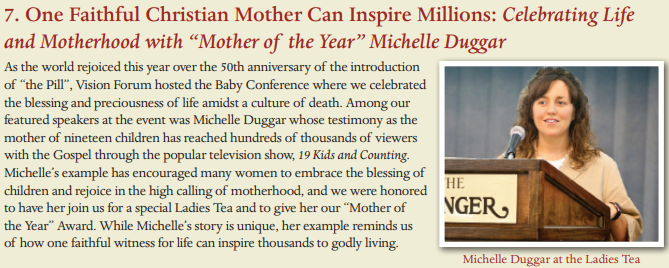
Beneath the CNP’s coordination sits a system built for something more specific than educating children: reproducing them, on purpose, inside the network, to keep the project running past the current generation’s lifetime. The college and camp pipeline already exists to hold that formation inside the movement end to end — Patrick Henry College, Liberty University, Bob Jones University, Hillsdale College, and New Saint Andrews for higher education explicitly marketed to homeschool graduates; IBLP’s ALERT Academy and Vision Forum’s own Father-Daughter and Father-Son retreats for the formation years in between. Those retreats were never framed as bonding trips. Vision Forum’s own catalog copy states the purpose directly: a father’s role is “preparing her as a young woman of purity for the young man of her dreams,” and when that relationship is “realized and cultivated, the generational mission of the Christian family is secure” (VF Catalog, 2006, pp. 70–71). The word chosen is not “happiness.” It is “mission,” and the mission has a defined output: another generation, raised the same way, ready to marry inside the same world and start again. That same theory of formation runs through explicitly political, rather than homeschool-specific, infrastructure too. Charlie Kirk’s Turning Point USA, already named above for funding buses to the January 6 rally, was built on precisely the model Vision Forum ran in miniature: reach young people early, shape their worldview through curricula and training rather than persuasion campaigns aimed at adults, and produce activists rather than simply voters. Turning Point Academy, the K-12 charter and private school network Kirk later launched, extends that model into the schoolhouse itself — an explicit alternative to “woke” public education, built for children rather than college students. Vision Forum trained culture warriors inside the home; Turning Point built the same pipeline inside a school building and a campus chapter room. Two organizations, one fundamentalist and one evangelical in its own self-presentation, arrived at the identical conclusion: if the fight is generational, the training has to start before the fighters are old enough to vote. That output required an explicit theology of reproduction, and Vision Forum supplied one repeatedly across nearly a decade. Nancy Campbell’s Be Fruitful and Multiply — “Birth control is now accepted by most churches. But what does the Bible say? Is it ever ‘good stewardship’?… Christians should cry out to the Lord to bless the fruit of the womb,” with a foreword by Doug Phillips himself — appears in the catalog from 2006 through 2011 (2006, p. 15; 2011, p. 29), alongside Demographic Winter and Demographic Bomb, two documentaries warning that “the global birthrate is declining with such ferocity that many nations may cease to exist” (2011, p. 29). Large families were not simply welcomed. They were positioned as a demographic front in the same war this paper has already traced through every other sphere. The clearest single statement of what that front was fighting came in 2010. As Vision Forum’s own year-in-review put it: “As the world rejoiced this year over the 50th anniversary of the introduction of ‘the Pill,’ Vision Forum hosted the Baby Conference where we celebrated the blessing and preciousness of life amidst a culture of death” (2011, p. 4). Featured speaker Michelle Duggar, mother of nineteen children and star of the reality show 19 Kids and Counting, received the company’s “Mother of the Year” award at that conference. The pairing is not incidental. The outside world’s fiftieth anniversary of reproductive control was answered, deliberately, with another institution’s award for reproductive maximization — the same year, framed as opposite responses to the same fact of the twentieth century.
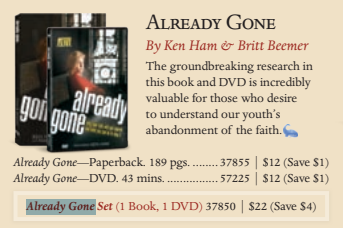
The plan was not naively confident about its own success, either. Vision Forum’s catalog sold Ken Ham and Britt Beemer’s Already Gone (2011), whose headline finding — that regular Sunday school attendance actually correlated with young people later leaving the church — was only the data point beneath a much more openly panicked argument (VF Catalog, 2011, p. 19). Ham opens the book touring England’s decommissioned churches, now nightclubs, mosques, and rock-climbing gyms, and warns his American readers that they are looking at their own future: “American Christianity could be on the edge of obsolescence in less than two generations.” (Ham & Beemer, Already Gone, 2011, “Final Thoughts”) His prescription is explicit and addressed directly to parents: “you can no longer depend on the Sunday school and youth ministries in your church to educate your kids in the things of God… This is your job; this is your responsibility.” (Ham & Beemer, Already Gone, 2011, “To Parents”) A movement this anxious about retention is a movement that understands exactly how much its entire strategy depends on the next generation choosing to stay. The anxiety is itself evidence: this was never passive culture, absorbed without effort. It was a plan, worked on deliberately, worried over constantly, and — as the movement’s own personnel now sitting inside a presidential administration attest — one that in large part worked.
V. Policy Translation and Documented Harm
The preceding section traced how this movement built the machinery — the legal shops, the pipeline schools, the confirmation networks, the think tanks writing the actual legislative language. Machinery is not self-justifying. It exists to do something. This section asks what. Three struggles anchor what follows: the fight over women’s bodily autonomy, beginning with abortion but extending to the broader theology of headship that governs it; the fight over racial equality, which the network under study did not avoid so much as actively rewrite, constructing an alternate history in which the two clearest instances of racial violence in the American record — Indigenous genocide and slavery — were never about race at all; and the fight over LGBTQ rights, encompassing both marriage and the more recent and more aggressive campaign against transgender Americans specifically. These are not the only civil rights struggles this movement’s institutional descendants have touched — immigration enforcement, disability rights, and labor protections all show up in the documentary record too — but they are the three most directly load-bearing for the theological argument this paper has been making since Section 3: that a specific reading of Calvin, filtered through Rushdoony’s dominion theology and enacted through Vision Forum’s model of the patriarchal household, produces a specific and predictable set of political targets. For each struggle, I follow the same four-part sequence: first, what Calvin, Rushdoony, or Marsden’s account of the movement said about the underlying theological question, on its own terms, before it became policy; second, what Vision Forum and the broader homeschool/patriarchy movement said and did about it, in its own primary-source language; third, how the Council for National Policy and the Heritage Foundation translated that theology into institutional strategy — model legislation, litigation, confirmed judges, Project 2025’s actual text; and fourth, what the current administration has done about it in the nineteen months since taking office. The point of holding this sequence constant across all three struggles is to make the throughline undeniable: this is not three unrelated culture-war fights that happen to share a political coalition. It is one theological architecture, applied three times.
Women’s Bodily Autonomy: Patriarchy from Geneva to the Reconciliation Bill Calvin’s ideal household was never merely domestic. In his commentary on Genesis 3:16, he reads Eve’s subjection to Adam not as a temporary consequence of the Fall to be mitigated by grace but as the restoration, under discipline, of an order that had existed since creation — the wife “reduced to a state of servitude” being, for Calvin, simply the correction of a disorder she had introduced by usurping headship in the garden in the first place. The household, in the Institutes, functions as the first and most basic unit of godly government, a microcosm of the civil order Calvin was simultaneously building in Geneva; a wife’s submission to her husband was not a private arrangement but a public good, the smallest visible instance of the same obedience owed by subjects to magistrates and by magistrates to God’s law. Rushdoony inherited this architecture directly and made it explicit doctrine: in the Institutes of Biblical Law, the family is “the basic government” ordained by God, prior to and more fundamental than the state, and the feminist movement’s challenge to patriarchal headship is treated not as a competing political claim but as rebellion against the created order itself — the same category of offense as civil insurrection. Marsden’s account of fundamentalism’s development supplies the connective tissue: as the movement hardened its boundaries against theological and cultural modernism in the early twentieth century, rigid gender roles became one of its most durable boundary markers, a place where “standing firm” against the world could be enacted in the most intimate and enforceable arena available — the home. Vision Forum’s Dominion Theology did not soften this architecture for a modern audience; it operationalized it. Its “Tenets of Biblical Patriarchy” stated plainly that “the God-ordained and proper sphere of dominion for a wife is the household,” that “a husband and father is the head of his household, a family leader, provider, and protector,” and that this headship “carries over into the church: only men are permitted to hold ruling positions” (Vision Forum Ministries, “Tenets of Biblical Patriarchy”). The Institute in Basic Life Principles — Bill Gothard’s parallel homeschool network, socially and personally intertwined with Vision Forum’s own circuit rather than merely adjacent to it, and given its most public face by the Duggar family, whose own attendance at Vision Forum conferences and appearances in Vision Forum’s publications this paper has already documented — taught an ‘umbrella of authority’ in which ‘a husband’s authority over his wife is God-given’ and a wife’s submission to it is a ‘non-negotiable duty… regardless of his ‘deficiencies” (IBLP). This was not a fringe position even by the movement’s own internal standards of moderation — and it is worth pointing out that the movement did have internal standards of moderation, and that Doug Phillips exceeded them. Michael Farris, HSLDA’s chairman and later president of Alliance Defending Freedom, later publicly criticized Phillips’s teaching that girls should never attend college and should remain in their father’s home until marriage — a rare instance of a Council for National Policy-adjacent figure drawing a line inside a movement built on drawing very few. The logic did not stay theoretical, either: Kevin Swanson, a recurring figure on the Vision Forum-adjacent media circuit, stated in 2015 that there is “nothing in God’s law that would prohibit a young girl who’s ready to get married, at 15 or 16 years of age” — a direct patriarchy-doctrine position on marriage age and the bodily autonomy of minors, delivered without apparent controversy inside the network that produced it. The Council for National Policy and the Heritage Foundation did not need to invent a new theology to build a legal strategy; they needed a litigation vehicle. Alliance Defending Freedom, founded in 1993 by Alan Sears, drafted the model legislation underlying Mississippi’s 2018 Gestational Age Act and served on the state’s defense team in Dobbs v. Jackson Women’s Health Organization, which overturned Roe v. Wade on June 24, 2022 (ADF, “Dobbs v. Jackson Women’s Health Organization”). The infrastructure around that case is the same infrastructure this paper has already traced: SBA Pro-Life America, National Right to Life, and March for Life supplied the sustained public advocacy and lobbying spend, while ADF supplied the legal argument. Since Dobbs, the strategy has widened rather than concluding — Heritage’s Emma Waters has argued that reviving the Equal Rights Amendment “could anchor a supposed right to abortion in the Constitution itself,” and FRC’s Patrina Mosley has called the ERA “a smokescreen for abortion” that “puts men in women’s shelters, prisons, bathrooms, showers, sports, and more” (Heritage Foundation, 2023; FRC, 2019) — language that quietly folds the abortion fight and the emerging anti-trans fight into a single argument, a convergence worth flagging now and returning to in the LGBTQ subsection. In January 2026, Heritage launched a “250 Year Plan” family-policy initiative explicitly targeting no-fault divorce for rollback, which the National Women’s Law Center characterized as an effort to “coerce women into marriage” (NWLC, 2026). And in a smaller but telling skirmish over the movement’s own usable past, historians working from a fourteen-thousand-document archive of Susan B. Anthony’s papers have found no evidence for the pro-life movement’s claim that Anthony opposed abortion — a dispute the Rochester museum dedicated to her calls “historically inaccurate” (Susan B. Anthony Museum & House) — which suggests a movement willing to conscript even a suffragist’s biography into service of an argument she never made. What the current administration has done with this architecture in its first nineteen months is not abstract. Within days of taking office, it revoked Medicaid guidance permitting cross-state abortion travel and rescinded the Department of Defense’s abortion-travel allowance for servicemembers (January 2025). Over the following year, it withheld twenty-two Title X family-planning grants (April 2025), finalized a VA rule prohibiting abortion counseling for veterans and their dependents (December 2025), and made abortion-providing clinics categorically ineligible for Medicaid reimbursement through a reconciliation-law provision (July 2025) — while HHS and the FDA opened a mifepristone safety review conducted, according to reporting, “outside standard FDA procedures” (Guttmacher Institute, “Year One of Project 2025 Tracker,” 2026). The measurable consequence of the underlying state-level bans this architecture built is now documented in the peer-reviewed literature: a JAMA study using CDC data across thirteen ban states found infant mortality rose 5.6 percent above the expected rate — roughly 478 excess infant deaths — with a 10.98 percent relative increase among Black infants specifically (Gemmill, Franks, Feller, & Bell, 2025). ProPublica’s reporting supplies the individual cases behind the aggregate number: Josseli Barnica, 28, who died in a Houston hospital in September 2021 after doctors delayed miscarriage treatment for roughly forty hours, reportedly citing Texas’s abortion law, in a death more than a dozen medical experts called preventable; and a Texas hospital-discharge analysis showing sepsis rates in second-trimester pregnancy loss rising from roughly 2.9 percent to 4.9 percent, alongside a 33 percent rise in the state’s overall maternal mortality rate even as the national rate declined (ProPublica, 2024–2025). The theology said a wife’s proper sphere of dominion was the household. The policy translation of that theology is a measurable rise in the number of women who do not survive it.
Race: Erasure as Doctrine
Calvin has almost nothing to say about race in any sense a modern reader would recognize, and that absence is itself instructive: the household government he built and the civil order he theorized in Geneva were constructed around confession, not complexion, and the theological architecture this paper has traced from Calvin through Rushdoony inherited that same structural blind spot. What it inherited instead, per Marsden’s account, was a posture of strategic withdrawal — fundamentalism’s founding move in the early twentieth century was to separate itself from the “Social Gospel” movement it associated with theological liberalism, and racial justice organizing was, historically, bound up with exactly the kind of “worldly” social reform fundamentalism was defining itself against. Rushdoony’s own writings drew direct scholarly criticism on this front: religious-studies scholar Julie Ingersoll, who had unrestricted access to Rushdoony’s personal papers, and historian Michael McVicar have both documented passages in his work that defenders characterize as a states’-rights argument against federal power and critics read as a defense of segregation dressed in theological language. This is contested terrain, and I am naming it as contested rather than resolving it — but the fact that it is contested at all, inside a body of work this paper otherwise treats as doctrinally central to the movement, is itself part of the record. What this inheritance produced, three generations later, was not silence. It was doctrine.
Vision Forum did not merely avoid the subject of race; it built a curriculum around unmaking it wherever American history made it unavoidable. Its “Christian Controversies in American History” series devoted entire lectures to relitigating the two moments in the national record where racial violence is least deniable, and arrived, in both cases, at the same conclusion: race was never really the issue. In “Pilgrims vs. Indians: Racial Genocide or Biblical Dominion in Colonial New England?” Doug Phillips invokes the “one blood” doctrine — “there is one race… not the red man race, the white man race, the black race” — and then spends the lecture constructing a hierarchy that does the same work race pseudoscience once did, minus the vocabulary: Indigenous nakedness, oral tradition, and resistance to conversion are read as evidence of demonic “devolution,” pilgrim killings are reclassified as self-defense or just war, and land purchase agreements are offered as proof there was no theft at all. Mainstream historical acknowledgment of Indigenous genocide is recast throughout as “revisionist,” a politically motivated assault on children’s heritage staged, per Phillips, by paid outside agitators — a framing consistent with Vision Forum’s decision to run Jamestown’s 2007 quadricentennial commemoration after local government declined to stage a major observance, given the weight of the genocide history attached to that anniversary. The companion lecture, “Yankees vs. Rebels,” performs the identical maneuver on slavery: speaker Bill Potter concludes that “slavery didn’t cause the Civil War, but it certainly was a factor,” cites the statistic that eighty percent of white Southerners owned no slaves to diminish the institution’s systemic centrality, and endorses Confederate Vice President Alexander Stephens’s postwar “Constitutional View of the Late War Between the States” as the accurate historical framework — federalism against centralism, tariffs, states’ rights. Left entirely unmentioned is the same Alexander Stephens’s Cornerstone Speech of March 1861, delivered weeks before the war began, in which he stated without qualification that the Confederacy’s foundation rested on “the great truth that the negro is not equal to the white man” and that slavery was his “natural and normal condition.” Potter cites the version of Stephens the movement could use and omits the version that would have ended the argument. Both lectures share a title convention worth naming on its own — “the war between the states,” offered as one interchangeable name among several — and both share a rhetorical engine: mainstream scholarship is “revisionist” politics, and the movement’s own curated counter-narrative is the recovery of buried truth. This was not a movement declining to discuss race. It was a movement teaching its children, by name, that the two clearest instances of racial violence in American history were never about race at all.
That doctrine did not stay confined to curriculum; it shaped the founding of the political coalition this paper has been tracing since Section 4. Paul Weyrich — co-founder of the Heritage Foundation in 1973 and, six years later, of the Moral Majority alongside Falwell and Howard Phillips — said so himself, and directly contradicted the origin story the movement would later tell about itself. Decades afterward, Weyrich stated plainly that abortion was not what brought evangelicals into politics: “What galvanized the Christian community was not abortion, school prayer, or the ERA… What changed their minds was Jimmy Carter’s intervention against the Christian schools, trying to deny them tax exempt status on the basis of so-called de facto segregation.” The IRS had moved against Bob Jones University’s tax-exempt status specifically because of its racially discriminatory policies, following a 1971 federal court ruling affirming the agency’s authority to deny exemptions to segregated private schools; Weyrich’s own account credits that fight, not Roe, as “more than any single act” in bringing fundamentalists and evangelicals into the political process (Balmer, “The Real Origins of the Religious Right,” 2014). The organization Weyrich co-founded — the same Heritage Foundation now authoring Project 2025 — was, on its own architect’s telling, born defending a segregated school’s tax exemption, in the same institutional and theological ecosystem that would, decades later, teach children that Indigenous genocide and slavery were revisionist inventions. The Council for National Policy’s current legal strategy on race runs through a narrower channel than its strategy on abortion or transgender rights: Edward Blum’s Students for Fair Admissions, working through the same litigation model as SFFA v. Harvard (2023), sued Kamehameha Schools in fall 2025 to end its Native Hawaiian-preference admissions policy, extending the same anti-race-conscious-policy theory across a third institution — though this connection runs through one individual’s litigation vehicle rather than direct institutional coordination by Heritage or ADF, a distinction worth preserving rather than collapsing.
The current administration’s actions on race in its first nineteen months have been less about any single dramatic policy than a systematic withdrawal of the federal government’s own tools for recognizing structural discrimination at all — the natural policy endpoint of a movement that has spent decades arguing racial harm cannot be structural in the first place. On April 23, 2025, the administration signed an executive order titled “Restoring Equality of Opportunity and Meritocracy,” directing federal agencies to “eliminate the use of disparate-impact liability in all contexts to the maximum degree possible” — disparate-impact analysis being the legal framework that allows discrimination to be identified by its effects on a group rather than requiring proof of explicit discriminatory intent, precisely the framework needed to see racism as anything other than an individual heart’s private sin, or, per Phillips and Potter, a historian’s political agenda. The order directed the Attorney General and the EEOC to review and act on pending investigations and lawsuits relying on disparate-impact theory within forty-five days, revoked presidential approval of Title VI regulations addressing discriminatory effects, and instructed the Attorney General to identify state disparate-impact laws for potential federal preemption. The EEOC subsequently announced it would stop investigating complaints about company policies that disproportionately harm certain groups without discriminating explicitly. The curriculum and the executive order, it turns out, are running the same argument: neither will admit that a structure — a school, a settlement, a hiring policy — can be discriminatory without a person intending it to be.
LGBTQ Rights: One Theology, Two Targets
Calvin’s Geneva did not treat sodomy as a private matter of conscience; civil records document executions under Geneva’s incorporation of Mosaic penalties into municipal law during Calvin’s own tenure (Naphy, Sex Crimes from Renaissance to Enlightenment), the same fusion of biblical statute and civil sword that would resurface, verbatim, four centuries later. Rushdoony made that fusion explicit and programmatic. In the Institutes of Biblical Law’s chapter on homosexuality, he does not merely restate Leviticus 20:13 as a moral teaching; he argues for its reinstatement as enforceable civil law: “Homosexual cultures are at war with God; in this war, there are no negotiations possible… God’s penalty is death, and a godly order will enforce it.” He frames homosexuality not as an act but as “a philosophical expression” of “the current denial of antithesis,” a symptom of “culminating apostasy” that appears “in every area of apostasy and time of decline” — an end-times marker, not a private sin. Notably, he specifies that the death penalty applies to men but not women, reasoning that “the man’s greater authority means greater moral responsibility and greater guilt in sinning” — the same patriarchal logic this paper traced in the abortion and women’s rights subsection resurfacing inside the penal code itself. The companion chapter on Deuteronomy 22:5, “The Transvestite,” extends the same framework to gender nonconformity broadly, and reads, at points, like a direct source text for the coded language Vision Forum would deploy decades later: Rushdoony warns against “the progressive desexualization of people,” the cultural drift toward “the bland, neutral person,” and a goal he names outright as “uniman” — the deliberate blurring of “the distinction between male and female.” Both chapters, notably, sit within Part VII of the Institutes, Rushdoony’s extended commentary on the Seventh Commandment, in the same taxonomic sequence as his chapters on incest and bestiality — a structural choice, not an accident of alphabetization, and it tells you plainly what category the theology places these things in. Vision Forum did not soften this inheritance; it marketed around it and, when the marketing needed cover, coded it. The clearest expression of the coding is also the closest verbal echo of Rushdoony’s own language: Family Man, Family Leader warned in its 2006 catalog listing that “absent a revival of fatherhood, we can expect to see an ever-increasing rise in the number of effeminate boys and masculine women” (VF Catalog, 2006, p. 14) — Rushdoony’s “uniman” and “bland, neutral person,” repackaged as a homeschool-dad book pitch, without ever naming transness directly. Where the catalog did name its target directly, the register shifted from theology to grievance and persecution. The 2005 catalog’s opening letter warned that “men have sought to redefine marriage to include the most perverse of human behavior,” and asked readers, “Can you remember when moral perversions were not mentioned in public (let alone glorified on national television)? Do you remember? I do” (VF Catalog, 2005, p. 2) — nostalgia functioning as argument. That same catalog sold Edwin Vieira’s How to Dethrone the Imperial Judiciary, which used same-sex marriage rulings as its central example of judicial overreach (VF Catalog, 2005, p. 12), a title the catalog continued selling every year afterward — the judiciary-as-enemy framing that will matter directly in Part 3. By 2012, the ministry’s own newsletter was casting itself as the target rather than the aggressor, claiming Vision Forum’s website had been “targeted by pro-homosexual community” cyberattacks timed to coincide with Doug Phillips’s public criticism of President Obama’s endorsement of same-sex marriage (“Eighteen Lessons from 2012,” p. 4) — the identical rhetorical move this paper has already tracked in the Race subsection, where mainstream acknowledgment of harm gets recast as a hostile political agenda and the movement’s own position gets recast as the besieged truth. And by 2014, the catalog was selling Kevin Swanson’s Apostate, which frames homosexuality alongside “demonic possession, insanity, suicide, mass-murder, adultery… and unbridled, maniacal apostasy” as evidence of “the decline and fall of Western civilization” (VF Catalog, 2014, p. 18) — Rushdoony’s “end-of-an-age phenomenon” language, forty years on, sold as a book with a trailer. Swanson did not confine that theology to book jacket copy. At his 2015 National Religious Liberties Conference, he cited Leviticus 20:13 directly to call for “the death penalty for homosexuals” — not a metaphor, not a rhetorical flourish, but Rushdoony’s civil-law prescription stated as current policy demand. Republican presidential candidates Ted Cruz and Mike Huckabee both attended that same conference, and the distance between “attended” and “current political structure” has only closed since: Cruz remains a sitting United States senator, and Huckabee is not a historical footnote at all — he was confirmed and sworn in in 2025 as the current administration’s Ambassador to Israel. The theology that produced “death penalty for homosexuals” as an applause line in 2015 is, ten years later, sitting inside the State Department. It is, across the whole of this network’s documented record, one of the clearest instances of the movement’s most extreme theological position sharing a room with the political power that would go on to hold it — and it sits directly upstream of the Council for National Policy and Alliance Defending Freedom’s own institutional strategy: ADF founder Alan Sears co-authored The Homosexual Agenda: Exposing the Principal Threat to Religious Freedom Today (2003), which the SPLC characterizes as linking homosexuality to pedophilia and “disordered sexual behavior” — Rushdoony’s theology in legal-advocacy prose, from the organization that would go on to argue Dobbs and, later, United States v. Skrmetti. This is the same fusion flagged in the abortion and women’s rights subsection, where FRC’s Patrina Mosley called the Equal Rights Amendment ‘a smokescreen for abortion’ that ‘puts men in women’s shelters, prisons, bathrooms, showers, sports, and more’ — one sentence collapsing reproductive rights and trans rights into a single threat, because for this network’s legal architecture, they always were. ADF filed the amicus brief and served as counsel for respondents defending Tennessee’s ban on gender-affirming care for minors, a case the Supreme Court decided 6-3 in the state’s favor on June 18, 2025; Family Research Council submitted its own supporting brief. And in February 2026, Heritage Foundation president Kevin Roberts said the quiet part aloud about the endpoint of that litigation strategy for adults, describing Heritage as “radical incrementalists” whose “ultimate goal via incremental steps” is banning gender-affirming care outright: “You outlaw it.” The current administration has moved on both fronts of this fight simultaneously, and moved fast. Within its first two weeks, it signed an executive order titled “Defending Women From Gender Ideology Extremism” (January 20, 2025), directing agencies to use “sex” rather than “gender” and reversing the Bostock-based reading of Title IX; a week later came EO 14183, “Prioritizing Military Excellence and Readiness” (January 27, 2025), banning transgender military service outright, following Project 2025’s own characterization of gender dysphoria as incompatible with service. A “Protecting Children From Chemical and Surgical Mutilation” order followed on January 28, banning federal support for gender-affirming care for minors and targeting Medicare/Medicaid coverage, and a sports-ban order came February 5, barring transgender women from women’s sports through the Olympic level. EO 14183 was blocked twice at the district level in March 2025 — one judge calling it evidence of “unadulterated animus” — before the Supreme Court allowed it to take effect pending appeal on May 6, 2025; the Court later upheld state bans on transgender athletes in women’s sports in a 2026 ruling. Turning Point USA supplied the cultural front in parallel: Charlie Kirk’s public record runs from misgendering content and sports-exclusion advocacy in 2020 through calling transgender people “a throbbing middle finger to God” (September 2023) and demanding “a Nuremberg-style trial for every gender-affirming clinic doctor” (April 2024), to advocating in August 2025 that vandalizing Pride murals should be legal. In July 2026, TPUSA CEO Erika Kirk told a chapter leadership summit to be “happy warriors” against “a trans, if it’s a gender-confused person, if it’s a Muslim,” framing the fight in explicitly religious-war terms. From Rushdoony’s civil death penalty to Kevin Roberts’s “you outlaw it,” the theology has been remarkably patient about the specific mechanism — church discipline, catalog marketing, litigation, executive order — but never ambiguous about the goal.
VI. Discussion
Recap:
Read end to end, Sections III through V do not describe three or four separate culture-war fights that happen to share a donor class and a Rolodex. They describe one theological claim, made in Geneva in the 1550s and never substantively revised, working itself out through nearly five centuries of institutional carriers until it produced a specific, predictable, and now-documented set of political targets. The claim is simple: Legitimate authority runs downward; from God to magistrate, from husband to wife, from parent to child, from the “saved” to the “unrepentant”. And any movement, legal theory, or policy that inverts or challenges that direction is not a competing political position to be negotiated with but a form of rebellion to be corrected. Calvin applied that claim to Geneva’s civil code. Rushdoony applied it to the American family and to the American penal code. Vision Forum, IBLP, and their associates applied it to homeschool curriculum, media production, entrepreneurial training, a catalog that did double duty as doctrinal expression, and “ten thousand” children, including me. The Council for National Policy and the Heritage Foundation applied it to litigation strategy and judicial appointments. The current administration is applying it to federal regulatory language. The mechanism doesn’t change. Only the paperwork does. Vision Forum’s 2005 catalog, whose cover art lived on the wall in my childhood home, was themed ‘A Line in the Sand’ - William Barrett Travis’s line at the Alamo, an invitation to stay and die rather than leave. Everything that follows in this section is written from the side of the line their theology never made room for: out.
What Section V demonstrates, project-wide, is that this is not merely a metaphorical or rhetorical throughline - rather, it is traceable, documented architecture. A specific reading of Genesis 3:16 in the 16th century can be followed directly to a specific executive order signed in the second week of the current regime. That traceability is my actual argument in this paper, and it’s worth staking a clear claim about before the rest of this section starts to complicate it: the central throughline holds. We’re going to take it seriously enough to stress-test it - against Weber’s more modest ambitions for “elective affinity,” against what the theory can’t explain, against the movement’s own internal fractures, and against what it looks like from inside rather than from the documentary record alone.
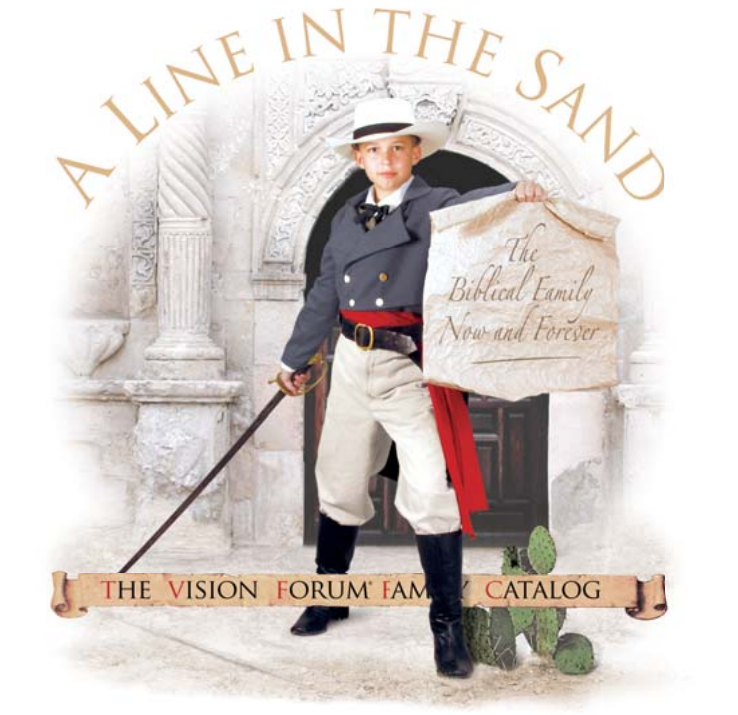
A Note on Research Method:
Every quotation from a Vision Forum catalog, every citation to Rushdoony’s Institutes of Biblical Law, every citation to Heritage Foundation commentary or Project 2025’s own text in this paper is, in a very literal sense, an institution’s account of itself - written by people with every incentive to control how it would later be read. Critical Race Theory’s insistence on counter-storytelling exists precisely because of that asymmetry: supposedly objective documentary and legal record is never actually neutral, it reflects whoever had the power, the platform, and the institutional apparatus to write it down (Delgado & Stefancic). The corrective CRT scholars propose is not to discard the documentary record but to place first-person testimony beside it on comparable evidentiary footing, particularly where - as in this paper - the documentary record was authored almost entirely by the institutions under examination. I am the one source in this paper that was never filtered through Vision Forum’s public relations apparatus, Heritage’s messaging discipline, or the CNP’s own self-mythology. That is not a weakness in the evidence. It is, following Delgado and Stefancic’s own argument, the entire point of including it. This is also why the personal material threaded through this paper follows Ellis, Adams, and Bochner’s autoethnographic method rather than appearing as unmarked anecdote: the observation gets stated plainly, and then immediately triangulated against existing scholarship - Butler, Emerson and Smith, the primary-source catalog record itself - so that it functions as illustration of a documented, external pattern rather than as a mere private grievance asking to be taken on blind faith. Where this paper claims that Vision Forum’s marketing echoed Rushdoony’s language on gender nonconformity, or that the movement’s own internal moderates drew lines that figures like Doug Phillips crossed, those are claims resting on citation. Where I say what it felt like to be the child those catalogs were marketing to, and that their curriculum was taught to, that claim rests on a different kind of evidence - but it is evidence, not decoration, and this paper treats it that way. The limitation of this method is real, and important to acknowledge rather than avoiding: first-person testimony gets dismissed, inside academic and legal spaces built to prize precedent and documentation over lived account, as “just anecdotes” - unrepresentative, too emotional to count. Counter-storytelling was never meant to replace the structural analysis presented above. It runs alongside it, filling in precisely what a catalog, a legal brief, or an executive order will never say about itself.
Elective Affinity, Outgrown
Weber’s Wahlverwandtschaft was a deliberately modest tool. He built it specifically to avoid two traps: Marxist economic determinism on one side, where he believed that ideas are just superstructure draped over material interest, and pure theological idealism on the other, where Calvinist doctrine simply caused capitalism by logical necessity. Elective affinity sits between them — an unplanned resonance between a belief system and a set of behaviors, each reinforcing the other without either one being reducible to a cause of the other.
Predestination anxiety didn’t order anyone to found a corporation. It produced a psychological condition — the search for assurance of election through worldly diligence — that happened to fit, like a key that wasn’t cut for this particular lock but turns it anyway, with the disciplined accumulation capitalism needed. That looseness of fit was the whole point of the concept. It let Weber make a claim about resonance without overclaiming causation he couldn’t actually document. This paper has spent three sections doing something Weber’s own methodology would have been more cautious about: naming names. Weber inferred affinity from correlation — Protestant regions industrialized faster, Calvinist sects produced disproportionate numbers of the entrepreneurial class — because he did not have, and could not have had, a documented chain of individual transmission from Geneva’s consistory to a Hamburg trading house. I have that chain. Rushdoony read Calvin. Howard Phillips organized under Rushdoony’s direct theological influence. Doug Phillips grew up in Howard Phillips’s house and named his own ministry’s curriculum after the same doctrine. I was raised on that curriculum, in a room with a Vision Forum catalog on the wall. That is not elective affinity. That is discipleship, with a documented syllabus, and it is a stronger and more specific claim than Weber’s original concept was built to make. So: does the extension do real theoretical work, or does it stretch a concept past where it explains anything? My answer is that it does real work, but not by successfully stretching elective affinity to cover political and reproductive behavior the way earlier sections implied — it works by revealing that this case has already outgrown elective affinity as its explanatory frame. Weber’s concept was correctly modest about what loose correlation could support. What Sections III through V document is not a resonance between an economic ethic and a set of institutions that happened to fit each other. It is direct, named, generational instruction, organized around a single doctrine of hierarchical authority, with an unbroken line of institutional succession from a sixteenth-century consistory to a twenty-first-century executive order. Calling that “elective affinity” is actually an undersell. The honest theoretical label is closer to what the sociology of religion calls institutional path-dependency: not two things that happen to fit, but one thing, handed down, that never had to fit anything because it never stopped being taught directly.
Honest Complications: What the Fractures Reveal
If the throughline this paper documents were a monolith — one unified command structure rather than one shared theological logic operating across independent institutional carriers — it should have no internal fractures worth mentioning. It has at least two, and they are not the same kind of fracture, which turns out to matter more than the fact of fracture itself. The first is between Michael Farris and Doug Phillips. His former employer before the founding of Vision Forum, Farris knew what Phillips was teaching — “unscriptural views about women,” in Farris’s own later phrase — for years before he said so publicly. HSLDA quietly stopped inviting Phillips to speak at its national conference; Farris “tried, by example, to keep this stuff outside the mainstream.” That is not silence out of ignorance. That is silence chosen, maintained, for years, right up until October 2013, when Phillips resigned from Vision Forum after admitting to a “lengthy… relationship with a woman” that was “inappropriately affectionate and romantic,” and April 2014, when a woman who had lived with the Phillips family since she was fifteen filed suit alleging years of sexual abuse. Only then, with Phillips already disgraced and Vision Forum already dissolved, did Farris go public: “Frankly, we think it’s time for us to stand up and publicly say this is just wrong.” His own Facebook admission a day later is the more honest sentence: “I wish I had spoken up sooner.” This was not the network catching and correcting its own extremism on principle. It was the network protecting its own respectability once protecting Phillips stopped being free. The second fracture is between Leonard Leo and Donald Trump. In June 2025, Trump attacked Leo — the Federalist Society figure most responsible for the judicial confirmation pipeline this paper has already traced through Sections IV and V — calling him a “sleazebag” who “probably hates America” after a string of judicial losses despite a bench stacked with Trump’s own appointees. This is not a doctrinal dispute. Trump was not accusing Leo of insufficient originalism. He was demanding personal loyalty in a currency the Federalist Society’s own founding claim — fidelity to constitutional text and precedent, not to any one president — was never built to pay in. Where Farris and Phillips fractured over a doctrine that both men, in their own telling, still believed, Leo and Trump fractured over whether doctrine matters at all once the man with the actual power no longer needs the institution’s legitimacy to get what he wants. These two fractures are not evidence against the throughline. But they are evidence of two different limits on it, and naming both honestly is more useful than treating “the network has internal disagreement” as a single finding. The Farris/Phillips break shows that this movement’s internal accountability mechanism, such as it is, activates reactively — once scandal creates cost, not before — which means the theology’s own account of itself as a check on abuse of patriarchal authority is considerably weaker in practice than in doctrine. The Leo/Trump break shows something different and, I’d argue, more structurally important: that the alliance between this theology’s institutional carriers and the raw political power they helped build was never symmetrical. The Council for National Policy and the Federalist Society needed Trump to enact their policy architecture. Trump, it turns out, does not need their doctrine at all — only their machinery, for exactly as long as the machinery keeps producing results he wants. Elective affinity, or institutional path-dependency, whichever term you use, described theology and power reinforcing each other. What June 2025 revealed is that the reinforcement only ever ran one direction as far as Trump personally was concerned. The theology built the machine. The machine no longer needs to believe in the theology to keep running.
The Individualist/Colorblind Mechanism
Section II introduced Emerson and Smith’s account of white evangelical “freewill individualist” theology — a framework with no doctrinal category for group-level or structural sin, which cannot register racism as anything other than an individual heart’s private failing. Section V’s Race subsection used that mechanism and then, without quite naming the move, exceeded it: the actual finding wasn’t that Vision Forum’s theology left it blind to race. It was that the theology required an active, produced, marketed counter-history, built specifically to prevent that blindness from ever being tested against the record. I want to name that gap directly here, because I sat inside it. Individualist blindness is a passive mechanism. It predicts an absence — a missing category, a failure to notice. What “Pilgrims vs. Indians”, “Yankees vs. Rebels”, and the movement’s biographies of Lee and Jackson actually are is not absence. They are hours of scripted, professionally produced argument, sold on a fixed schedule, built specifically to construct a counter-history and train children to call the mainstream account “revisionist” while calling the curated one the recovery of buried “Providential” truth. Emerson and Smith’s framework explains why nobody producing that curriculum felt like they were doing something racist — the theology genuinely has no self-accusing category for what they were doing. It does not explain why the lecture series had to be produced, scripted, and sold in the first place. Blindness doesn’t require a script. This did. The mechanism the paper needs alongside individualism, then, isn’t a replacement for it — it’s a second, more active process running at the same time: dominion theology doesn’t merely tolerate a whitewashed founding myth, it structurally requires one. The entire premise of “restoring” a Christian America - the rhetoric from my childhood that is all too recognizable in the “Make America Great Again” slogan - depends on America having actually been a godly nation to restore. If the founding record includes Indigenous genocide and slavery defended in explicit racial-theological terms, the founding stops being an inheritance worth reclaiming and becomes something the movement’s own theology would have to condemn. The curriculum could not simply fail to mention this — it had to argue it away, on tape, by name, because the entire dominion project depends on a usable origin story. Individualism explains the absence of guilt in the room. Dominion theology’s need for a redeemable founding explains the presence of the lecture series. Both were operating on me in my own home education at the same time, and Emerson and Smith’s framework alone only accounts for the first one.
Purity Culture Begets Rape Culture
The movement’s own vocabulary already gives away the mechanism, if you know where to look for it. “Umbrella of authority” — the phrase IBLP used to describe a wife’s or daughter’s covering under her husband’s or father’s protection — was never really about protection. It was about liability. A woman standing under the umbrella was shielded from consequence only for as long as she stayed under it; a woman who stepped out from under it, whether by disobedience, by immodesty, or simply by being harmed while standing somewhere the men around her had failed to secure, forfeited the shield along with the covering. IBLP said as much explicitly: submission was a “non-negotiable duty… regardless of his deficiencies.” The deficiency clause is the whole doctrine in miniature. It tells you in advance that when something goes wrong, the fault line will run through her position, not his conduct. Vision Forum’s own catalog copy ran on the identical logic. The “Tenets of Biblical Patriarchy” didn’t describe protection as something a household provided regardless of a woman’s behavior; it described protection as the reward for a woman’s correct position inside a hierarchy she did not design and could not appeal. This is what has become known as purity culture. It is not a cousin of that later, more widely recognized label, or a private dialect of it — it is the thing itself, printed in a catalog years before the term caught on outside these circles. The Rebelution’s 2007 Modesty Survey is the clearest single artifact I can point to for how thoroughly that architecture had saturated the broader homeschool-fundamentalist world by the time my generation was coming up inside it. Alex and Brett Harris — sons of Gregg Harris, one of the movement’s own “four pillars of homeschooling,” and young men who would go on to campaign for an Alabama judge who admired Doug Phillips openly — surveyed more than 1,600 young men on what women wore that caused them to stumble. A hundred and forty-eight questions. The results, when Alex and Brett published their summary, were treated as data about female responsibility: girls learned that ordinary exercise clothing registered as “immodest” to three-quarters of the respondents, that they bore the evaluative burden for a stranger’s internal reaction, that — in the survey’s own published language — a girl who dressed a certain way could “lose their right to ask guys to stop looking at her like something to be had.” I want to sit with that sentence rather than paraphrase past it, because it says the quiet part in plain English: certain conduct converts a girl into a thing that can be looked at, and once converted, she has surrendered standing to object. Shaney Irene, who took the survey as a teenager and wrote about it years later, called her own compliance a regret she carried into adulthood. She is not an outlier. She is the intended outcome. This is not a tangential curiosity about one parachurch youth ministry. It is the same family of theology this paper has been tracing from Geneva forward, applied at the level of a teenage girl’s wardrobe instead of a nation’s civil code, and it produces the same structural result every time it is applied: responsibility migrates toward whoever has the least power to refuse it, and protection becomes conditional on a performance that can always, after the fact, be judged to have failed. That is not purity culture and rape culture existing as uncomfortable neighbors. It is one theology of conditional protection, running the same program on two different scales. And this is where the record stops being theoretical. Both institutional pillars this paper has followed most closely produced exactly the outcome their own doctrine made structurally likely, and both did it at the level of their own founders and flagship families, not at some deniable periphery. Bill Gothard resigned from IBLP in March 2014 after thirty-four women came forward alleging sexual harassment and four alleged molestation, including one woman who said Gothard molested her at seventeen — allegations that also included failures to report child abuse within the ministry itself. Doug Phillips resigned from Vision Forum Ministries that same year, after the woman he had employed as a family “nanny” and household nanny-companion disclosed a years-long pattern of sexual abuse and coercion that Phillips’s own legal filings would later characterize, in an argument that speaks for itself, as consensual. Two men who built their entire public authority on the claim that they alone could be trusted to define the terms of a woman’s protection turned out to be the two men their own movement’s daughters and employees needed protection from. The Duggar family’s own history closes the circle rather than complicating it. As IBLP’s most public and most photographed family — the family that brought the umbrella-of-authority theology to a television audience Vision Forum’s catalog never reached, the same family this paper has already placed inside Vision Forum’s own conferences and publications — the Duggars were the movement’s living proof of concept: large, disciplined, godly, protected. In May 2015, police reports from 2006 became public showing that Josh Duggar, the eldest son, had molested five minor girls between 2002 and 2003, four of them his own sisters, when he was fourteen and fifteen years old. The family’s and the ministry’s response at the time was internal correction and prayer, not intervention on the victims’ behalf — the umbrella held over the son, not the daughters standing under it with him. That was not the end of the story. In December 2021, a federal jury convicted Josh Duggar of receiving and possessing child sexual abuse material; in May 2022 he was sentenced to 151 months, roughly twelve and a half years, in federal prison. The same umbrella language that told a fifteen-year-old rape-survey respondent she had forfeited her right to object was, in this family, sheltering an actual perpetrator, twice, nine years apart. I am not naming Gothard, Phillips, and Duggar to argue that this theology makes abuse inevitable in every household it touches, or that every family raised inside it produced a predator. It didn’t, and it doesn’t. I am naming them because a theology of conditional protection, applied consistently across an entire movement for a generation, does not produce these outcomes as freak coincidences at its two most visible institutional centers. It produces them as the predictable output of a system built to protect the position of authority first and ask questions about conduct only when the position could no longer absorb the cost of silence. Michael Farris’s break with Phillips corrected a person. It did not, and could not, correct the theology, because the theology was never the anomaly that produced Phillips, or Gothard, or the Duggar household’s own internal handling of what it already knew — it was the baseline condition every girl in these spaces, myself included, was raised inside. The scandals were legible as scandals, eventually, once they became public enough to require a response. The survey, the catalog copy, the umbrella language — those were never scandalous. They were curriculum.
Culture War
I want to return, for a moment, to a detail this paper already put on the record and then moved past too quickly: eleven years of Vision Forum catalog themes, one after another, framed as campaign names. Discipleship and Dominion. A Line in the Sand. Faith of Our Fathers. Providence and Perseverance. A Vision of Victory. Provision and Protection. Fight Hard and Hold Fast. I called that, earlier, “a decade of a company telling its own customers, every single year, that they were at war.” I want to say plainly now what that vocabulary was actually doing, because it was not marketing flourish. It was training. A curriculum built around siege language does two things at once, and both matter more than the aesthetic. It tells the child inside it that the world outside the household is hostile — not mistaken, not pluralistic, not simply different, but actively at war with them — and it tells that same child that the household itself is a unit inside a command structure, not a private family making its own choices. Rushdoony gave that structure its explicit theory: “dedicated minorities,” “conspiracies of friendship,” the deliberate language of a movement that understood itself as a disciplined force rather than a voluntary association of the persuaded. Once a family accepts that framing, obedience inside the household stops being merely a domestic virtue and becomes something closer to military discipline — questioning the umbrella isn’t disagreement anymore, it’s desertion. That is not a metaphor I am imposing on the material. It is the metaphor the material chose for itself, year after year, on its own catalog covers. The same architecture scaled up cleanly, because it was never really about a catalog. Paul Weyrich did not build the Moral Majority and the Council for National Policy as a debating society; he built them, by his own account, as an army responding to a specific attack — the loss of Bob Jones University’s tax exemption — with race as the actual trigger and abortion added later as the more presentable banner. Kevin Roberts, running the organization Weyrich founded, closed that loop explicitly in 2024, calling the current moment “the second American Revolution, which will remain bloodless if the left allows it to be” — a sentence that only makes sense as a threat if you already accept the premise that the other side started the war. Kevin Swanson’s “nothing in God’s law” framing and his later Nuremberg-adjacent rhetoric run on the same logic: once your opponents are combatants rather than fellow citizens, the available responses expand to include things that would be unthinkable against a fellow citizen. Charlie Kirk’s “throbbing middle finger to God” and his demand for “a Nuremberg-style trial for every gender-affirming clinic doctor” are not outliers inside this vocabulary. They are its most honest expression. And Erika Kirk’s instruction to a room of chapter leaders in July 2026 — be “happy warriors” against “a trans… a gender-confused person… a Muslim” — states outright what the catalog covers spent two decades implying: this was never a metaphorical war. It was always meant to produce actual soldiers, and it has. I sat inside that command structure - raised as the oldest child of a regular speaker, writer, and conference coordinator in the Vision Forum and Homeschool conference circuit - long enough to know what it asks of the people standing in its ranks, and it is not primarily belief. It is obedience under a hierarchy that has already told you the alternative is annihilation. That is the piece purity culture and this section share a hinge with: a household governed like a unit at war does not tolerate insubordination from the people it has designated as needing protection, because insubordination in wartime is not a disagreement to be worked out, it is a threat to the whole formation. The umbrella of authority and the war catalog are the same doctrine wearing two different uniforms — one domestic, one civilizational — and both exist to make the same demand: stay in formation, or forfeit the protection formation was supposed to provide.
On A Personal Note
Everything above this line was written to be fact checked: a catalog quote, a court filing, a peer-reviewed study, a name and a date. I have tried to earn every editorial sentence in this Discussion the same way; stated plainly, then set beside the record it rests on. What follows does not stop making that argument, but it does stop asking to be graded on it. I spent the Discussion section analyzing the household I was raised in with the same tools I used on Geneva’s consistory. What’s left is to say, plainly and without a citation behind it, what all of it amounts to, and to whom I’m actually saying it.
VII. Conclusion
Synthesis
Calvin did not build a machine for producing Project 2025. But a machine is exactly what got built, one generation and one doctrine at a time, and the paper trail is not circumstantial. It runs from Calvin’s Geneva, where a wife’s submission was civic order in miniature and a household’s discipline was evidence of election, through Rushdoony’s Institutes, where that same household became “the basic government” and Mosaic penalties became a civil-law proposal rather than a historical curiosity, through Vision Forum and IBLP, where the theology was operationalized into a curriculum, a catalog, and a generation of children raised to see themselves as soldiers in a war their parents had already declared — through the Council for National Policy and the Heritage Foundation, where the theology became litigation strategy and model legislation, and finally into an administration currently executing that legislation with a measurable body count. Emerson and Smith’s individualist mechanism explains why the broader evangelical world could watch this happen and call it something else. It does not explain what I watched happen from inside the room where the curriculum was written — because what I watched was not blindness. It was construction, and I have shown my work.
On Method
I told you at the start of Discussion that I would use my own testimony as evidence, triangulated against the documentary record rather than offered instead of it, and I have tried to hold that standard for every claim I made about what I saw and heard. I am not a neutral observer of this material, and I have not pretended to be one. I am, instead, the kind of witness this movement’s own theology insists cannot exist: a daughter of the household who grew up, left, and wrote it down. That is not a conflict of interest. It is the entire point.
What This Argument Cannot Carry
I want to say plainly, one more time, what I am not claiming, because a paper this pointed and this exhaustive deserves to be precise about its own edges. I am not arguing that every homeschooling family, every Reformed church, or every person who has ever used the word “dominion” in a sentence is complicit in what this paper documents. I grew up alongside people who took the same curriculum and built ordinary, decent, unremarkable lives out of it. I am arguing something narrower and, I think, more defensible: that a specific theological architecture, when adopted by specific institutions and pursued with the discipline this movement brought to it, produces a specific and now well-documented set of outcomes — in law, in policy, and in the bodies of the people who lived inside its households. The mechanism is traceable. The outcome was not inevitable for every family it touched. Both of those things are true at once, and a paper that pretended otherwise would not have earned the right to say anything else in it.
The Architects Are Disappearing
There is a pattern among this movement’s first-generation leaders that the second generation does not get the luxury of following. Doug Phillips did not simply retreat from public life after 2014 — he rebranded, writing under the byline “DW Phillips” as a Ukraine war correspondent for the Kyiv Post and his own “Ukraine Story” newsletter, presenting to readers who have never heard of Vision Forum as an ordinary conservative journalist, the curriculum nowhere in his byline. James and Stacy McDonald, who edited Homeschooling Today Magazine before my own father did, and whose Passionate Housewives Desperate for God sat on the same catalog pages as Vision Forum’s “Tenets of Biblical Patriarchy,” have scrubbed that chapter from their public profiles almost entirely. Stacy’s 2023 essay “A Bruised Reed” comes closer than either Phillips or my father to an actual accounting — “I regret so much of what I taught over the years, and I realize I wasn’t qualified to be teaching or counseling anyone,” she wrote, worrying that her own writing on female submission “may have caused more confusion and harm to women who read my books while suffering in (or after) abusive relationships” — but even that reads as private regret offered to a sympathetic audience, not a public reckoning with the material harm the teaching did, and it has not stopped the books themselves from remaining in print. My own father, once an influential editor inside this same network, has not gone even that far — deleted, scrubbed, unfindable unless you know exactly what you’re looking for.

Joshua Harris is the exception worth naming, because he is one. I Kissed Dating Goodbye shaped this world’s theology of courtship as much as anything Vision Forum printed, and when Harris came to believe it had caused harm, he apologized by name in 2016, disavowed the book in 2018, and left the faith entirely by 2019 — publicly, under his own name, absorbing the criticism. That is the distinction this section is actually about: one man broke publicly and let the record stand. The others are trying to make the record disappear, or, at most, quietly regret it out of public view. My generation — the one that curriculum was built to produce, not the one that profited from selling it — is left holding whatever is going to survive of it. I know, personally, other leaders from both generations who have begun the process of walking away from this world and are simply not yet ready to put their names to what they saw. This paper does not need them to be ready. It only needs the record to exist for whenever they are.
To Whoever Reads This and Recognizes It
Here is what nobody tells you when you’re still inside: the people who built this movement were not lying about the stakes. They believed they were fighting a war for a nation’s soul, and organized decades of institution-building, curriculum, and judicial appointment around that belief - and it worked far better than most of the country understood until recently. I am not writing this to tell you the war wasn’t real. I am writing it to tell you that you are allowed to have survived it, and to say so, in your own name, in public, with your own evidence. That is true whether your experience of being raised in this subculture is one of simply surviving, or whether you were - as part of the leading edge of the second generation - a part of furthering the agenda. I have drawn a sharp line in this paper between the leaders who are trying to erase their own record and the ones who simply left quietly, still unsure how to talk about what they did or watched happen. If you are in that second group, this paper is an invitation too. You do not owe anyone a confession staged on someone else’s timeline. But the record does not get more honest for your silence, and neither does the healing. Testimony is data. Not decoration for someone else’s data — admissible on its own terms, the way a catalog quote or a court filing is admissible. Everyone who lived inside this network, on either side of the pulpit, holds a piece of the record no archive holds, because it was never written down anywhere except in what happened to them, or in what they did. This paper has argued that the movement’s own primary sources indict it. I want to close by arguing something else: your memory is a primary source too, whichever side of it you were standing on, and it does not need the movement’s confession to count as evidence. That is the work I am building next, past the edges of this paper: a place to collect that evidence the way this paper collected it — sourced, triangulated, taken seriously as scholarship rather than filed away as grievance. Not a memorial to what the movement did. A record, built by the people it raised and the people who led it, of what actually happened inside the households it was certain no one outside would ever see. The architects who once preached about “tearing down strongholds” are disappearing. Someone has to hold the record they’re trying to erase - and some of them, I think, are waiting for permission to be the ones who hold it instead. If my documentation of this network reminds you of your own story, you’re not alone. Write it down.
References
- Alliance Defending Freedom. (n.d.). Dobbs v. Jackson Women’s Health Organization. https://adflegal.org ↑ back to top
- Balmer, R. (2014, May 27). The real origins of the religious right. Politico Magazine. ↑ back to top
- Butler, A. (2021). White evangelical racism: The politics of morality in America. University of North Carolina Press. ↑ back to top
- Calvin, J. (1559/1960). Institutes of the Christian religion (F. L. Battles, Trans.; J. T. McNeill, Ed.). Westminster John Knox Press. ↑ back to top
- Campbell, N. (2003). Be fruitful and multiply: What the Bible says about having children. Vision Forum Ministries. ↑ back to top
- Delgado, R., & Stefancic, J. (2017). Critical race theory: An introduction (3rd ed.). New York University Press. ↑ back to top
- DiMaggio, P. J., & Powell, W. W. (1983). The iron cage revisited: Institutional isomorphism and collective rationality in organizational fields. American Sociological Review, 48(2), 147–160. ↑ back to top
- Dobbs v. Jackson Women’s Health Organization, 597 U.S. 215 (2022). ↑ back to top
- Ellis, C., Adams, T. E., & Bochner, A. P. (2011). Autoethnography: An overview. Forum: Qualitative Social Research, 12(1). ↑ back to top
- Emerson, M. O., & Smith, C. (2000). Divided by faith: Evangelical religion and the problem of race in America. Oxford University Press. ↑ back to top
- Executive Order, Defending Women From Gender Ideology Extremism, 90 Fed. Reg. (January 20, 2025). ↑ back to top
- Executive Order, Protecting Children From Chemical and Surgical Mutilation, 90 Fed. Reg. (January 28, 2025). ↑ back to top
- Executive Order, Restoring Equality of Opportunity and Meritocracy, 90 Fed. Reg. (April 23, 2025). ↑ back to top
- Executive Order 14183, Prioritizing Military Excellence and Readiness, 90 Fed. Reg. (January 27, 2025). ↑ back to top
- Family Research Council. (2019, January 9). Family Research Council opposes the “Equal Rights Amendment” [Blog post]. https://www.frc.org/blog/2019/01/family-research-council-opposes-equal-rights-amendment ↑ back to top
- Gemmill, A., Franks, A. M., Anjur-Dietrich, S., Ozinsky, A., Arbour, D., Stuart, E. A., Ben-Michael, E., Feller, A., & Bell, S. O. (2025). US abortion bans and infant mortality. JAMA, 333(15), 1315–1323. https://doi.org/10.1001/jama.2024.28517 ↑ back to top
- Guttmacher Institute. (2026). Year one of Project 2025 tracker. ↑ back to top
- Ham, K., & Beemer, B. (2011). Already gone: Why your kids will quit church and what you can do to stop it. Master Books. ↑ back to top
- Harris, J. (1997). I kissed dating goodbye. Multnomah. ↑ back to top
- Heritage Foundation. (2023). Mandate for leadership: The conservative promise. ↑ back to top
- Ingersoll, J. (2015). Building God’s kingdom: Inside the world of Christian Reconstruction. Oxford University Press. ↑ back to top
- Kruse, K. M. (2015). One nation under God: How corporate America invented Christian America. Basic Books. ↑ back to top
- Lutheran Church—Missouri Synod, Commission on Theology and Church Relations. (1996). Racism: A Christian response. ↑ back to top
- Marsden, G. M. (2006). Fundamentalism and American culture (2nd ed.). Oxford University Press. ↑ back to top
- McDonald, J., & McDonald, S. (2005). Passionate housewives desperate for God: Learning to love what really matters. Vision Forum Ministries. ↑ back to top
- McDonald, S. (2023). A bruised reed. stacymcdonald.com. https://stacymcdonald.com/bruised-reed/ ↑ back to top
- McVicar, M. J. (2015). Christian reconstruction: R. J. Rushdoony and American religious conservatism. University of North Carolina Press. ↑ back to top
- Naphy, W. G. (2002). Sex crimes from Renaissance to Enlightenment. Sutton Publishing. ↑ back to top
- National Women’s Law Center. (2026). The group behind Project 2025 plans to restore the “American family” by coercing women into marriage. https://nwlc.org/resource/the-group-behind-project-2025-plans-to-restore-the-american-family-by- coercing-women-into-marriage/ ↑ back to top
- Nelson, A. (2019). Shadow network: Media, money, and the secret hub of the radical right. Bloomsbury. ↑ back to top
- NWA Homepage. (n.d.). Josh Duggar trial: A timeline of events. https://www.nwahomepage.com/josh-duggar-trial/josh-duggar-trial-a-timeline-of-events/ ↑ back to top
- Phillips, B. (n.d.). Verses of virtue: The poetry and prose of Christian womanhood. Vision Forum Ministries. ↑ back to top
- Phillips, D. (2013, May). The “miracle” of dad’s ten thousand grandchildren. Vision Forum Ministries. ↑ back to top
- Phillips, D. (n.d.). Poems for patriarchs: The verse and prose of Christian manhood. Vision Forum Ministries. ↑ back to top
- Rauschenbusch, W. (1907). Christianity and the social crisis. Macmillan. ↑ back to top
- Redden, M., Kroll, A., & Surgey, N. (2024, October 28). ‘Put them in trauma’: Inside a key MAGA leader’s plans for a new Trump agenda. ProPublica / Government Executive. https://www.govexec.com/management/2024/10/inside-key-maga-leaders-plans-new-trump-agenda/ 400607/ ↑ back to top
- Religion News Service. (2014, March 6). Conservative leader Bill Gothard resigns following abuse allegations. https://religionnews.com/2014/03/06/conservative-leader-bill-gothard-resigned-following-abuse-alle gations/ ↑ back to top
- Rlstollar. (2021, November 10). Do hard-right things: How Alex and Brett Harris’s Rebelution promotes extremism. https://rlstollar.com/2021/11/10/do-hard-right-things-how-alex-and-brett-harriss-rebelution-promote s-extremism/ ↑ back to top
- Rushdoony, R. J. (1973). The institutes of biblical law (Vol. 1). The Craig Press. ↑ back to top
- Sears, A., & Osten, C. (2003). The homosexual agenda: Exposing the principal threat to religious freedom today. Broadman & Holman. ↑ back to top
- Shiny Happy People [Docuseries]. (2023). Amazon Studios / Prime Video. ↑ back to top
- Southern Poverty Law Center. (2026). Alliance Defending Freedom [Extremist file]. https://www.splcenter.org/resources/extremist-files/alliance-defending-freedom/ ↑ back to top
- Students for Fair Admissions v. Harvard, 600 U.S. 181 (2023). ↑ back to top
- Susan B. Anthony Museum & House. (n.d.). Susan B. Anthony abortion dispute [collection reference]. https://en.wikipedia.org/wiki/Susan_B._Anthony_abortion_dispute ↑ back to top
- Swenson, A. (2024, July 4). Leader of the pro-Trump Project 2025 suggests there will be a new American Revolution. Politico. https://www.politico.com/news/2024/07/04/leader-of-the-pro-trump-project-2025-suggests-there-w ill-be-a-new-american-revolution-00166583 ↑ back to top
- Taylor, M. D. (2024). The violent take it by force: The Christian movement that is threatening our democracy. Broadleaf Books. ↑ back to top
- Trangerud, H. A. (2025). Our man at the top: How the Seven Mountains Mandate and Paul Weyrich’s Last Testament have shaped the presidency of Donald Trump. Studies in Religion / Sciences Religieuses. Advance online publication. https://doi.org/10.1177/00084298251392087 ↑ back to top
- United States v. Skrmetti, 605 U.S. ___ (2025). ↑ back to top
- U.S. Department of Justice, Western District of Arkansas. (2022, May 25). Former reality television personality sentenced to 151 months in federal prison for downloading child sexual abuse material [Press release]. https://www.justice.gov/usao-wdar/pr/former-reality-television-personality-sentenced-151-months-fe deral-prison-downloading ↑ back to top
- Vision Forum Ministries. (n.d.). Tenets of biblical patriarchy. ↑ back to top
- Vision Forum Ministries. (2003). Vision Forum catalog. ↑ back to top
- Vision Forum Ministries. (2005). Vision Forum catalog. ↑ back to top
- Vision Forum Ministries. (2006). Vision Forum catalog. ↑ back to top
- Vision Forum Ministries. (2007). Vision Forum catalog. ↑ back to top
- Vision Forum Ministries. (2008). Vision Forum catalog. ↑ back to top
- Vision Forum Ministries. (2010). Vision Forum catalog. ↑ back to top
- Vision Forum Ministries. (2010). Vision for 2011 [Newsletter]. ↑ back to top
- Vision Forum Ministries. (2011). Vision Forum catalog. ↑ back to top
- Vision Forum Ministries. (2012). Eighteen Lessons from 2011 and Eighteen Visions for 2012 [2011 Newsletter]. ↑ back to top
- Vision Forum Ministries. (2014). Vision Forum catalog. ↑ back to top
- Waters, E. (2023, March 1). Want to protect life? Oppose revival of the Equal Rights Amendment. The Heritage Foundation. https://www.heritage.org/life/commentary/want-protect-life-oppose-revival-the-equal-rights-amend ment ↑ back to top
- Ward, H. D. (2018). Misrepresenting Susan B. Anthony on abortion [Blog post]. National Susan B. Anthony Museum & House. https://susanbanthonyhouse.org/blog/misrepresenting-susan-b-anthony-on-abortion/ ↑ back to top
- Weber, M. (2002). The Protestant ethic and the spirit of capitalism (S. Kalberg, Trans.). Roxbury. (Original work published 1905) ↑ back to top
- Whitehead, A. L., & Perry, S. L. (2020). Taking America back for God: Christian nationalism in the United States. Oxford University Press. ↑ back to top
- Wikipedia contributors. (n.d.). Institute in Basic Life Principles. In Wikipedia. https://en.wikipedia.org/wiki/Institute_in_Basic_Life_Principles ↑ back to top
- Wikipedia contributors. (n.d.). Joshua Harris (author). In Wikipedia. https://en.wikipedia.org/wiki/Joshua_Harris_(author) ↑ back to top
- How Russell Vought’s ‘radical constitutionalism’ could spark a constitutional crisis. (2025, February 12). On Point, WBUR. https://www.wbur.org/onpoint/2025/02/12/russell-vought-radical-constitutionalism-trump-constituti onal-crisis ↑ back to top
If this resonates with your own experience, here’s how to add your voice.